📋 Who Should Read This Guide
Every week, we receive messages from overseas buyers who have just purchased a Chinese electric vehicle — excited about the car, but stuck with a problem they didn't see coming: the VIN doesn't exist in the manufacturer's after-sales database. No master account. No OTA updates. No remote vehicle control. A vehicle that works perfectly on the road, but is invisible to the cloud services it depends on.
This guide explains why this happens, and more importantly — how to prevent it before you pay. It is based on a real diagnostic case handled by our team in June 2026, where a customer in the Middle East purchased what appeared to be a new vehicle from an authorized dealer, only to discover it was a factory test vehicle never intended for public sale.
Also see: EV Training Program Evaluation: 5 Criteria for Choosing a Workshop — for workshops building Chinese EV repair capability, and our hands-on training programs.
🔍 The Case: A Brand-New Car That Wasn't
In early June 2026, a customer from the Middle East contacted us via WhatsApp. He had purchased a Chinese premium electric SUV through an authorized local dealership — a well-known dealer that had sold over 2,000 vehicles the previous year. The car drove perfectly. It was clean. It came with all the paperwork: invoice, registration card, export documents.
There was only one problem. The T-box — the vehicle's telematics unit that handles mobile connectivity, remote vehicle control, OTA updates, and cloud services — could not be activated.
⚠️ The Customer's Situation
- 1.Vehicle's built-in eSIM could not find any network signal in the customer's country
- 2.Customer bought a Chinese SIM card but the vehicle had no physical SIM slot — only eSIM
- 3.Without T-box connectivity, master account registration was impossible
- 4.Without a master account: no remote vehicle control, no OTA updates, no navigation activation
- 5.Customer's friends with other Chinese EV brands had all successfully activated their systems via SIM slot modification + master account registration — same fix, different outcome
The customer had already tried every channel available. The dealer who sold him the car — couldn't help. The brand's regional representative for the Middle East — gave incorrect information, claiming the vehicle didn't have a T-box at all. A quick photo from the customer proved otherwise.
"I am starting to not like the car because no one wants to help me activate the T-box. I know many friends they have other Chinese EVs and all of them they made master account and now they have the system working, except me. You are my last chance."
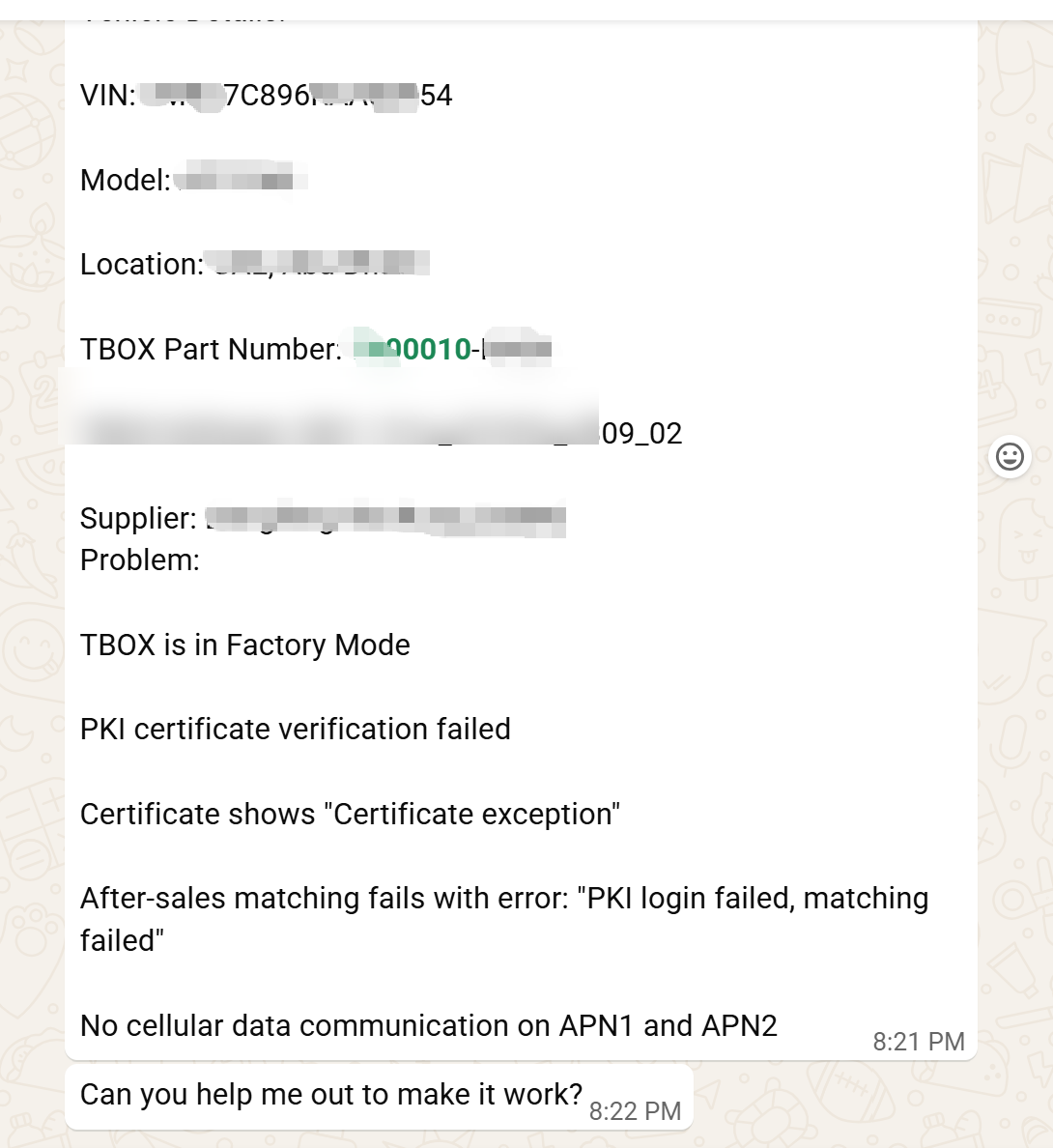
The actual T-box diagnostic data the customer sent us — Factory Mode, PKI certificate failure, and no cellular data communication. Screenshot shared with customer permission.
🔬 Our Diagnostic Process — Step by Step
What separates professional remote diagnostics from guesswork is structured verification. Here is exactly what we did:
Step 1: VIN Database Lookup
Submitted the vehicle's VIN to the manufacturer's engineering team for database verification — the same internal database used for warranty claims and after-sales support.
✗ VIN Not Found
The VIN did not exist in China's after-sales database. Confirmed as a factory test vehicle — produced before mass production for internal testing only.
Step 2: SIM Modification Assessment
Evaluated soldering a physical SIM card adapter to the T-box motherboard — a known fix when the Chinese eSIM won't roam overseas. Hardware: feasible. But...
✗ Useless Without VIN
Even with a physical SIM providing internet access, the master account server would reject the VIN on authentication. Hardware can't fix an identity problem.
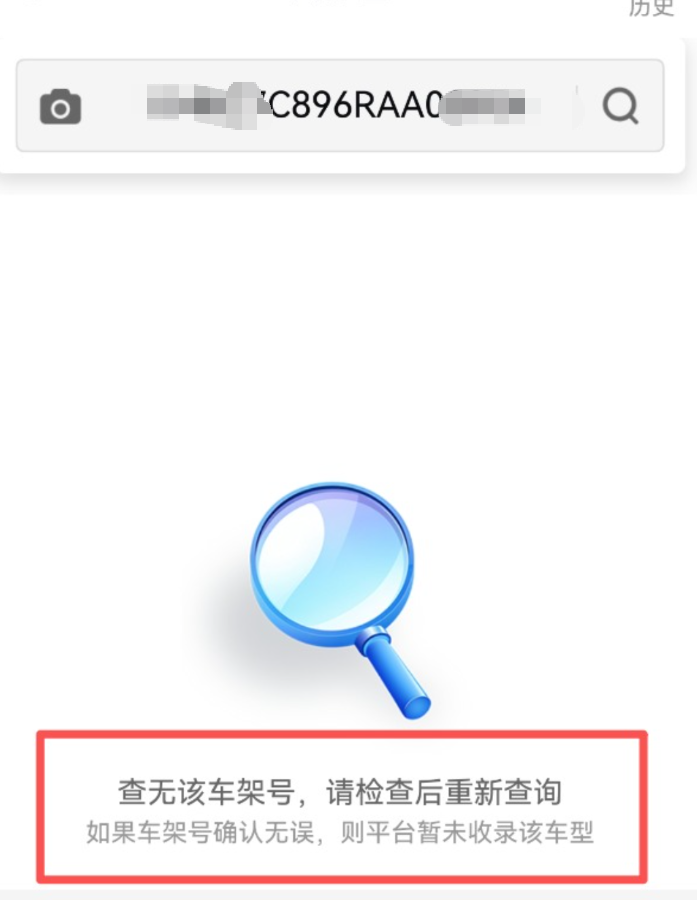
VIN database lookup result from the manufacturer's after-sales system — the VIN was not found, confirming this was a factory test vehicle never registered for public ownership.
We gave the customer the honest answer: this vehicle cannot be registered. The customer even offered to fly to China and visit the manufacturer's service center with all documents. We had to advise against it — the problem wasn't proving ownership. It was that the vehicle, by its nature, was never meant to receive standard after-sales support.
Our recommendation: contact the seller and seek compensation. The vehicle works mechanically, but its digital identity — the master account, the OTA provisioning, the cloud connectivity — will never function.
🏭 How Does This Happen? — The Test Vehicle Lifecycle
This is the most important section for overseas buyers to understand. It explains why the manufacturer is not at fault, and where the actual risk lies.
Normal Lifecycle of a Factory Test Vehicle
After testing, vehicles are legally sold to third-party dismantling companies. Their job: scrap the vehicle, sell usable parts. The manufacturer's legal obligation ends at sale.
Every car model, before entering mass production, produces dozens to hundreds of test vehicles for durability testing, crash testing, NVH evaluation, extreme environment testing, and more. These vehicles are not registered in the after-sales system because they were never intended for public ownership.
⚠️ What Happened — The Chain Was Broken
The dismantler and/or the overseas receiving party bypassed the scrapping step and exported the vehicle as new. The manufacturer had no visibility into this.
The vehicle itself may be mechanically sound — it was built for testing, after all. But its digital identity — the VIN in the after-sales database, master account eligibility, OTA provisioning, cloud certificate — was never created for public ownership. This is not a fixable defect. It is a supply chain provenance issue.
✅ Pre-Purchase Verification Checklist — 9 Checks Before You Buy
Based on this case and our experience handling similar situations for buyers in 15+ countries, here is a practical checklist. Complete these checks before transferring money — not after.
🆘 What If You Already Bought the Car?
If you find yourself in the same situation — vehicle mechanically works but VIN doesn't exist in the database:
⚠️ The Hard Truth
In our experience, there is no technical fix for a vehicle whose VIN doesn't exist in the manufacturer's database. You cannot:
- Create a master account — the server will reject the unknown VIN
- Enable OTA updates — the cloud platform has no record of this vehicle
- Replace the T-box with one from a legitimate VIN — modern Chinese EVs bind vehicle identity across multiple ECUs (Gateway, BCM, ADAS, Telematics), making isolated part swaps unreliable
- Flash custom firmware — the authentication chain from T-box to cloud requires manufacturer-signed certificates
Your best course of action: contact the seller immediately and pursue compensation. Present the evidence: the VIN verification result, the vehicle's test unit status, and the impossibility of standard after-sales support. If the seller is an authorized dealership, escalate to the manufacturer's regional office. The vehicle may still have value as a mechanically functional car, but it will never deliver the full ownership experience that a legitimate export unit provides.
🛡️ How NEV Fix Can Help You Avoid This
At NEV Fix, we have direct channels to manufacturer engineering teams across major Chinese EV brands. Before you commit to a purchase, we can:
🔍
VIN Verification
Submit any VIN and we'll check it against the manufacturer's internal database — the same one used for warranty and after-sales.
📋
Status Confirmation
Confirm production status (mass production vs. test unit), master account eligibility, T-box activation, and OTA support.
📞
Pre-Purchase Consultation
Not sure which checks apply to your situation? Contact us with the vehicle details and we'll advise before you commit.
We have handled similar cases for buyers across Russia, CIS, the Middle East, Brazil, and Southeast Asia. In most cases, a 5-minute VIN verification before payment would have prevented months of frustration and financial loss.
Need to Verify a Chinese EV VIN Before Purchase?
Send us the VIN and we'll check it against the manufacturer's internal database. Most verifications completed within 1 business day.
❓ Frequently Asked Questions
How can I verify a Chinese EV's VIN before buying?
Submit the VIN to NEV Fix. We have direct access to manufacturer engineering teams and can check whether the VIN exists in China's after-sales database — the same system used for warranty claims and service records. We can also confirm production status (mass production vs. test unit), master account registration eligibility, and T-box activation status. Most verifications are completed within 1 business day.
What is a test vehicle and why is its VIN not in the database?
Every Chinese EV model produces dozens to hundreds of test vehicles before mass production begins. These vehicles undergo durability, crash, NVH, and extreme environment testing. After testing, they are legally sold to third-party dismantling companies for scrap and parts recycling. Because test vehicles are never intended for public sale, their VINs are not entered into the manufacturer's after-sales database. If a test vehicle bypasses the dismantling step and enters the export market, it will appear mechanically sound but will have no digital identity — no master account, no OTA, no warranty.
What is a master account and why do overseas buyers need it?
A master account is the primary user identity registered in the manufacturer's cloud platform, linked to the vehicle's VIN. It enables remote vehicle control (lock/unlock, climate pre-conditioning, location tracking), over-the-air (OTA) software updates, navigation activation, and access to connected services. Chinese EVs are heavily software-dependent — without a master account, many smart features simply do not function. Overseas buyers must confirm master account eligibility before purchase, as not all export vehicles support registration.
Can a test vehicle's T-box be fixed or replaced?
No. The T-box (telematics box) is only one link in a chain. Even if you solder a physical SIM card adapter for overseas network access, the cloud server will reject the VIN during authentication because it does not exist in the after-sales database. Replacing the T-box with one from a legitimate VIN is also ineffective — modern Chinese EVs bind vehicle identity across multiple ECUs (Gateway, BCM, ADAS, Telematics), and the authentication chain requires manufacturer-signed digital certificates tied to the original VIN.
Is this problem common with all Chinese EV brands?
No. This is not a brand-specific problem — it is a supply chain integrity issue that can affect any Chinese EV brand. Legitimate export vehicles from all major manufacturers (BYD, NIO, Li Auto, Zeekr, Xpeng, Chery, and others) have valid VINs in the after-sales database and support master account registration. The risk arises when a test vehicle that was supposed to be scrapped enters the export market through unauthorized channels. This is why pre-purchase VIN verification matters regardless of brand.
What documents should I check before buying a Chinese EV overseas?
Beyond the standard invoice and registration documents, request: (1) the VIN and verify it against the manufacturer's database, (2) export documentation with matching VIN, (3) written confirmation of production status (mass production unit, not pre-production or test), (4) warranty coverage confirmation, and (5) where possible, a vehicle provenance clause in the purchase contract. See the full 9-point checklist in this guide above.
Which countries does NEV Fix provide VIN verification for?
NEV Fix provides VIN verification and pre-purchase consultation for buyers in all countries we serve: Russia, CIS countries, UAE, Saudi Arabia, other Middle Eastern markets, Brazil, Southeast Asia, and Europe. Our manufacturer access covers all major Chinese EV brands. Contact us via WhatsApp (+86 13609008707) or email (cnwangs@163.com) with the VIN and vehicle details.
Can NEV Fix verify my VIN before I buy?
Yes. Send us the VIN, brand, model, and any seller information you have. We will check the VIN against the manufacturer's internal after-sales database and confirm: (1) whether the VIN exists in the system, (2) production status — mass production or test/pre-production unit, (3) master account registration eligibility, and (4) T-box activation and OTA update support. Most verifications are completed within 1 business day. This is a real service — contact us via WhatsApp (+86 13609008707) or email (cnwangs@163.com) before you commit to a purchase.