📊 Quick Market Summary
- Growing numbers of China-spec electric vehicles are being exported to markets without official dealer networks — from the Caribbean to Central Asia to the Middle East
- Chinese manufacturers apply server-side region locks to domestically sold vehicles; operating outside mainland China triggers "authorized sales area" warnings that can disable connectivity and app features
- NEV Fix has unlocked several region-locked Chinese EVs using OEM unlock codes — a vehicle-specific, server-authorized process that preserves factory firmware intact
- Firmware flashing — whether for region bypass or Android infotainment upgrades — carries significant brick risk and should be avoided wherever an unlock code solution is available
- As more Chinese EVs appear in unsupported territories, the demand for safe, verified unlocking methods will continue to grow through 2027 and beyond
In late June 2026, NEV Fix's WhatsApp support line received a detailed inquiry from the Caribbean. A workshop in Sint Maarten — an island territory in the northeastern Caribbean — had a Zeekr 7X on their hands. The vehicle was showing a persistent warning: "Vehicle exceeded authorized sales area." A soft reset would clear it, but after a few days it would return.
This is not an isolated incident. As Chinese electric vehicles find their way to every corner of the world — through parallel imports, personal relocations, and independent exporter channels — the region lock problem is affecting more and more owners. And the solutions offered online range from unreliable DIY workarounds to potentially disastrous firmware operations.
Here is exactly what happened, what we recommended, and what every workshop and owner should know about unlocking a Chinese EV safely.
⚡ The core insight of this case: This was not a hardware repair. It was not a software reflash. It was an OEM cloud authorization issue that could only be resolved through the correct technical channel — a VIN-tied unlock code entered through the vehicle's own infotainment system. Understanding this distinction is the difference between a 5-minute fix and a potentially bricked vehicle.
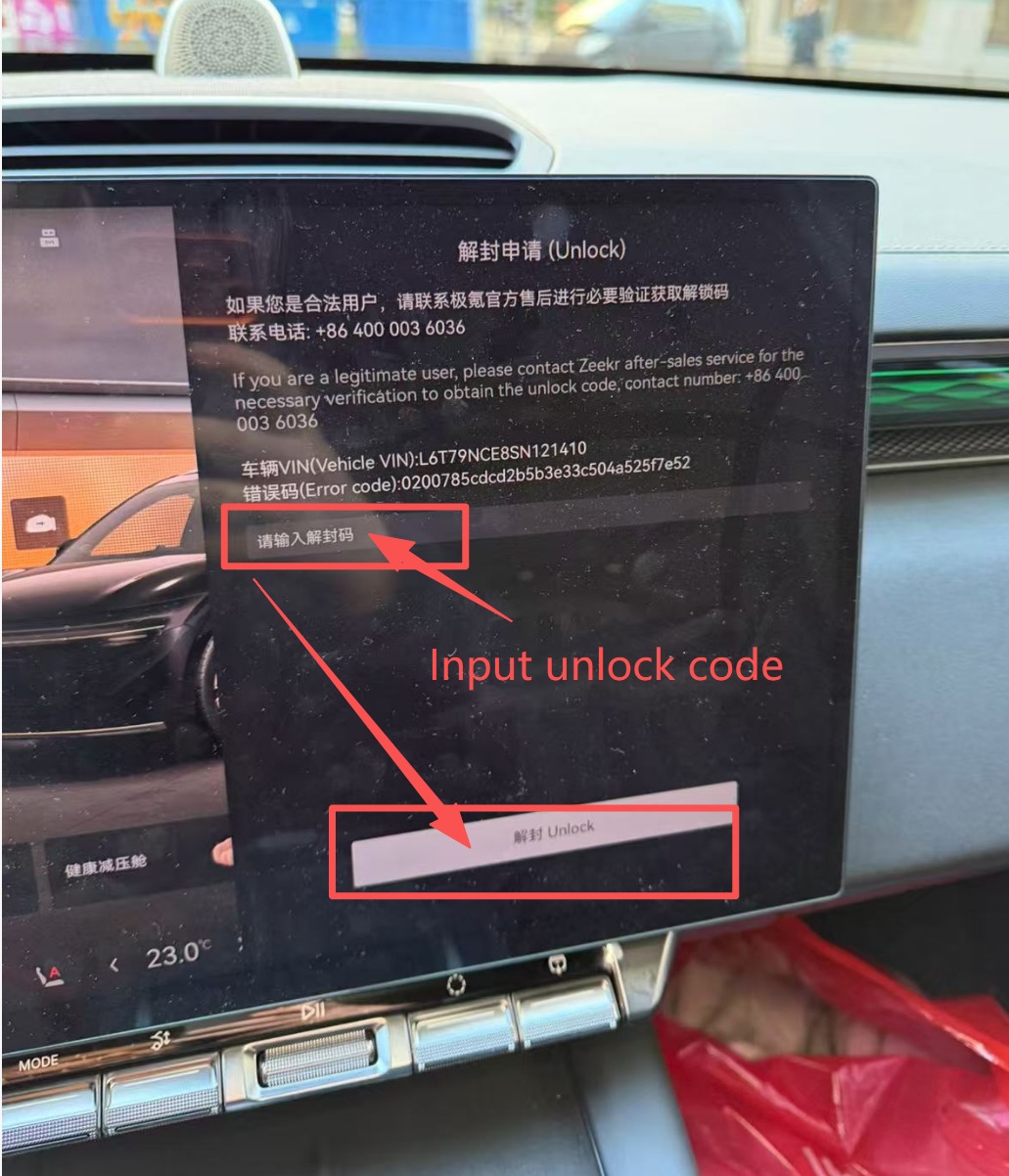
The Zeekr 7X infotainment screen as first seen by the client in Sint Maarten — the 解封申请 (Unlock Application) prompt with VIN and vehicle-specific error code. This is the screen every workshop in this situation will encounter.
Case Timeline: From Warning to Full Recovery
Vehicle Arrives in Sint Maarten
A 2025 Zeekr 7X (China-spec) arrives in the Caribbean through an independent export channel. The owner soon notices a persistent warning on the infotainment screen.
Client Attempts Soft Reset
A soft reset temporarily clears the "authorized sales area" warning. After a few days it reappears. The client also considers flashing the Android infotainment system to change the region — a path we strongly advised against.
Client Contacts NEV Fix — Remote Assessment
The workshop sends 7 detailed technical questions via WhatsApp. NEV Fix's engineering team analyzes the VIN prefix (L6T = Geely China domestic) and the symptom pattern (reset clears temporarily → re-triggers). Assessment: server-side region lock, resolvable via OEM unlock code.
VIN Verification → OEM Unlock Code Generated
Payment confirmed. Vehicle nameplate photo and owner ID verified. The VIN-specific unlock code is generated through the manufacturer's authorization system and delivered within 2 working days.
Server Unlock Completed — Vehicle Fully Restored ✅
Client enters the unlock code on the infotainment touchscreen. The server removes the regional authorization flag. Full connectivity, app access, and OTA updates restored. No firmware modified. No hardware touched. Process complete in under 10 minutes on the vehicle side.
Last updated: June 2026
The Inquiry: A Zeekr 7X in the Caribbean
The client — an independent workshop owner in Sint Maarten — reached out with a specific set of questions. He had a 2025 Zeekr 7X (VIN prefix L6T, confirming Geely manufacture for the Chinese domestic market) that kept displaying the authorization warning. He wanted to understand his options before committing to any intervention.
His questions were methodical and well-informed — exactly the kind of due diligence that separates serious workshops from people following random YouTube tutorials. He asked 7 specific questions, which we'll reproduce below along with our full responses.
About the Zeekr 7X: The Zeekr 7X is Geely's premium electric SUV launched in 2024 for the Chinese market. It runs on Geely's SEA (Sustainable Experience Architecture) platform, features an 800V electrical architecture, and uses a Qualcomm Snapdragon 8295-powered infotainment system. Like most China-spec EVs, its telematics module (T-Box) is configured to communicate with servers in mainland China — and to flag vehicles operating outside authorized regions. NEV Fix has worked with several Zeekr models through its remote diagnostic service, and the region-lock pattern is consistent across Geely's EV brands.
What Is the "Authorized Sales Area" Restriction?
Before diving into the Q&A, it helps to understand what this warning actually means. It is not a vehicle fault. It is not a defect. It is an intentional server-side restriction built into the vehicle's connectivity architecture.
Here is how it works:
- T-Box communication. Every modern Chinese EV has a Telematics Box (T-Box) that communicates with the manufacturer's cloud servers. It reports GPS location, vehicle status, and system health data — similar to how remote diagnostic sessions access vehicle data through a secure gateway.
- Location verification. The server periodically checks the vehicle's GPS coordinates against its designated sales region. A vehicle sold domestically in China is flagged for the Chinese mainland.
- Restriction trigger. When the vehicle operates outside its authorized region for an extended period, the server triggers the warning. Depending on the manufacturer, this may disable certain connected features — app remote control, OTA updates, and in some cases navigation and data services.
- Why manufacturers do this. It is primarily a commercial policy decision: domestic pricing, warranty terms, and after-sales infrastructure are designed for the Chinese market. Vehicles exported outside official channels create support liabilities that manufacturers are not equipped to handle — which is why independent services like NEV Fix's parts sourcing and remote diagnostics have emerged to fill that gap.
This is why a reset clears the warning temporarily but does not solve the problem. The T-Box will reconnect to the server, the server will check the GPS location again, and the restriction will be reapplied. The only permanent solution is to remove the restriction at the authorization level.
The Client's 7 Questions — And Our Answers
What follows are the exact questions the client asked, along with our full responses. We reproduce them here because these are the same questions that any workshop or owner facing a region lock should be asking.
💰 Cost & Timeline: The unlock code for this Zeekr 7X was priced at RMB 5,000. The timeline: payment via Alipay or WeChat Pay → provide photos of vehicle nameplate (with VIN) and owner identification → unlock code delivered within 2 working days → enter code on infotainment system → process complete. The vehicle-side operation takes approximately 5–10 minutes.
⚠️ The Second Request: Why We Said No to Android Flashing
After discussing the unlock, the client raised a second request: he wanted to remotely flash or upgrade the vehicle's Android-based infotainment system. Perhaps it was running an older version, or perhaps he wanted to install a specific region's software build.
We strongly advised against it. Here is why — and this applies to any Chinese EV, not just Zeekr.
⚠️ Critical Warning — Do Not Flash Infotainment Remotely: Chinese EV infotainment systems are not standalone Android tablets. They are deeply integrated with vehicle control networks — climate control, driving mode selection, energy management, battery monitoring, and vehicle configuration settings all pass through or are affected by the head unit. Flashing the wrong firmware, a mismatched region build, or an interrupted flash can leave the head unit in an unbootable state — a brick. When the head unit is bricked, the driver loses access to climate controls, charging settings, and many vehicle configuration functions. In severe cases, the only repair is a complete hardware replacement shipped from China.
We have heard from overseas owners who attempted infotainment firmware modifications and ended up with black screens — a problem that NEV Fix's engineers have been called in to triage after the fact. The cost of a replacement head unit, shipping, and installation can exceed the vehicle's value for some older models. This is not a theoretical risk — it is a documented pattern in Chinese EV owner communities.
✅ OEM Unlock Code (Our Approach)
Method: Server-side authorization change
What changes: Nothing on the vehicle
Risk of brick: Zero — no software modified
Reversibility: Not needed — permanent
Affects warranty: No — factory firmware intact
❌ Firmware Flashing (Risky Approach)
Method: Overwrite onboard software
What changes: Operating system, modules
Risk of brick: High — power loss = dead unit
Reversibility: None if flash fails mid-process
Affects warranty: Yes — modified software detected
The key insight: a region lock is a server-side authorization flag, not a software bug. It cannot be fixed by flashing firmware. Anyone offering to solve this problem by flashing your vehicle's software is either misunderstanding the problem or taking an unnecessary risk with your hardware.
The Broader Picture: Chinese EVs in Unsupported Markets
The Sint Maarten Zeekr is part of a larger trend. Chinese electric vehicles are reaching markets that have no official Geely, BYD, NIO, or Zeekr dealerships — and no authorized service centers. The vehicles arrive through parallel trade channels, personal imports, and independent exporters. As NEV Fix has seen through inquiries from 40+ countries, the owners face a common set of challenges:
- No warranty coverage outside China. Domestic warranty terms explicitly exclude vehicles operated outside mainland China.
- No dealer support. The official service network does not extend to unsupported territories, leaving owners to find independent solutions like NEV Fix's remote technical support.
- Server-side restrictions. Connectivity-dependent features may be disabled or restricted based on GPS location — exactly the problem this case study addresses.
- Language barriers. Infotainment systems may be locked to Chinese language, with no option to switch to English or other languages in settings.
- Parts availability. OEM parts are not stocked by local distributors, requiring direct sourcing from China — which is why NEV Fix maintains a verified OE number database covering 500+ part numbers for Chinese EV models.
For independent workshops in these territories, this represents both a challenge and an opportunity. The first workshop in a region to develop competence with Chinese EVs — including understanding region-specific issues like server locks — will build a reputation that attracts owners from across the country and beyond. Sint Maarten to the wider Caribbean is one example; similar patterns are developing in Central Asia, the Middle East, Africa and Latin America.
For workshops looking to build Chinese EV diagnostic capability from scratch, NEV Fix's 7-day Guangzhou training program covers high-voltage safety, BMS repair, and manufacturer-specific diagnostic workflows. The program includes hands-on sessions with actual Chinese EV components and remote support pricing that makes ongoing technical assistance accessible for independent shops.
What Did We Learn? — Key Lessons From This Case
Every real case teaches something. Here is what this Zeekr 7X experience reinforced for our team — and what independent workshops around the world should take away.
💡 Lesson 1: Not every warning requires ECU programming.
The "authorized sales area" warning looks like a vehicle fault but originates from a cloud server policy. Replacing hardware or flashing modules would not solve it — only an OEM authorization change could. Knowing when NOT to start a repair is as valuable as knowing how to repair.
💡 Lesson 2: Many China-spec EV problems originate from cloud authorization, not vehicle hardware.
Region locks, OTA access, app connectivity — these are increasingly server-managed functions. A vehicle with perfect hardware can still be partially disabled by a server-side flag. Diagnosing this correctly avoids unnecessary hardware replacements that cost thousands of dollars.
💡 Lesson 3: Replacing ECUs would not solve this specific issue.
A common but expensive mistake: assuming the T-Box or gateway module is faulty and replacing it. In this case, all hardware was functioning normally. The restriction was purely authorization-based. An ECU swap would have cost more, taken longer, and still failed — because the new ECU would receive the same server-side restriction based on the VIN.
💡 Lesson 4: OEM server authorization was the correct repair path — not firmware flashing.
The client initially considered flashing the Android infotainment to "change the region." This would have been: (a) ineffective against a server-side flag, (b) high-risk for bricking the head unit, and (c) unnecessary since the OEM unlock code path is simpler, safer, and permanent. The right repair path is the simplest one that targets the actual cause.
Who Should Read This Article
This case study is useful for a range of professionals dealing with Chinese EVs outside official dealer networks:
🛠️ Independent Workshops
Any shop outside China that may receive a China-spec EV with connectivity warnings. Understanding cloud-authorization issues saves diagnostic time and avoids wrong repairs.
🚢 Vehicle Importers & Exporters
Companies sourcing Chinese EVs for markets without dealer networks. Knowing that region locks can be resolved pre-sale adds value and reduces post-delivery complaints.
🚗 Chinese EV Owners Overseas
Individuals who purchased or relocated a China-spec EV to a country without dealership support. This article explains what the warning means and what a safe fix looks like.
🏢 Fleet Operators
Taxi and ride-hailing companies operating Chinese EVs in unsupported regions. Fleet-wide region-lock issues can disable entire vehicle groups simultaneously — having a verified unlock path matters.
🏛️ Insurance & Accident Repair Centers
Adjusters and repair facilities that encounter Chinese EVs in claims. Recognizing that a warning is a server-lock rather than accident damage prevents incorrect damage assessments.
Key Takeaways for Overseas Chinese EV Owners
| Scenario | What to Do | What to Avoid |
|---|---|---|
| "Authorized sales area" warning | Contact a verified service provider for an OEM unlock code tied to your VIN | Soft resets, clearing cache, GPS spoofing — all temporary and will re-trigger |
| Infotainment language or version | Check if the OEM offers a multi-language firmware update through official channels | Flashing unofficial firmware, custom ROMs, or third-party "region change" packages |
| Vehicle repairs or diagnostics | Use a service with OEM-compatible diagnostic tools and remote engineer access | Generic OBD scanners — they cannot access deep-level Chinese EV systems |
| Parts replacement | Source through a verified Guangzhou-based parts supplier with OE number cross-referencing | Ordering without verifying OE number compatibility — wrong parts are costly and slow |
| OTA updates not working | Confirm whether the region lock has been removed; OTA may resume after unlocking | Manual firmware updates from unofficial sources — high brick risk |
Last updated: June 2026
Important: Not Every Region Lock Can Be Removed
It is important to be transparent about this. The Zeekr 7X case had a successful outcome because the vehicle met specific conditions. Not all China-spec EVs qualify for an OEM unlock code — and we want owners and workshops to understand the boundaries before they reach out.
✅ When Unlocking Is Usually Possible
- Vehicle was originally sold in China through official channels
- VIN is valid and matches manufacturer records
- Vehicle has no blacklist flags (theft, finance default, export violation)
- T-Box hardware is intact and communicating normally
- Cloud services have not been permanently disabled by the OEM
- Vehicle identity (VIN, modules) has not been tampered with
❌ When We Cannot Help
- VIN has been blacklisted by the manufacturer (theft, fraud, export ban)
- OEM has permanently disabled cloud access for that VIN
- Previous illegal firmware modification has destroyed the vehicle's authentication certificates
- Vehicle identity has been changed or cloned (mismatched VINs across modules)
- The T-Box or gateway module has been physically damaged or removed
If your vehicle falls into the second category, we will tell you honestly rather than attempt a process we know will fail. This is why we ask for VIN verification as the first step — it allows us to check eligibility before any commitment or payment.
Required Information — What to Prepare Before Contacting Us
To help us assess your case quickly and accurately, please have the following ready when you reach out:
| Required Item | Why We Need It |
|---|---|
| 📋 Vehicle VIN | To verify the vehicle's identity, manufacturing origin, and check for blacklist flags |
| 🚗 Vehicle Model & Year | To confirm the specific model variant and platform (different Zeekr models may have different authorization paths) |
| 📍 Current Country | To understand the regulatory environment and connectivity requirements |
| 🖥️ Infotainment Software Version | To confirm the current firmware build and compatibility with the unlock code generation system |
| 📸 Photo of the Warning Screen | To verify the exact warning message and rule out other types of issues (some warnings look similar but have different causes) |
| 📄 Photo of Vehicle Nameplate (VIN plate) | Required by the OEM authorization process — the VIN must match manufacturer records exactly |
| 🪪 Owner Identification | Required for compliance with the manufacturer's unlock authorization protocol |
Having these items prepared before your first message allows us to move directly to VIN verification and provide you with an eligibility assessment — usually within the same business day.
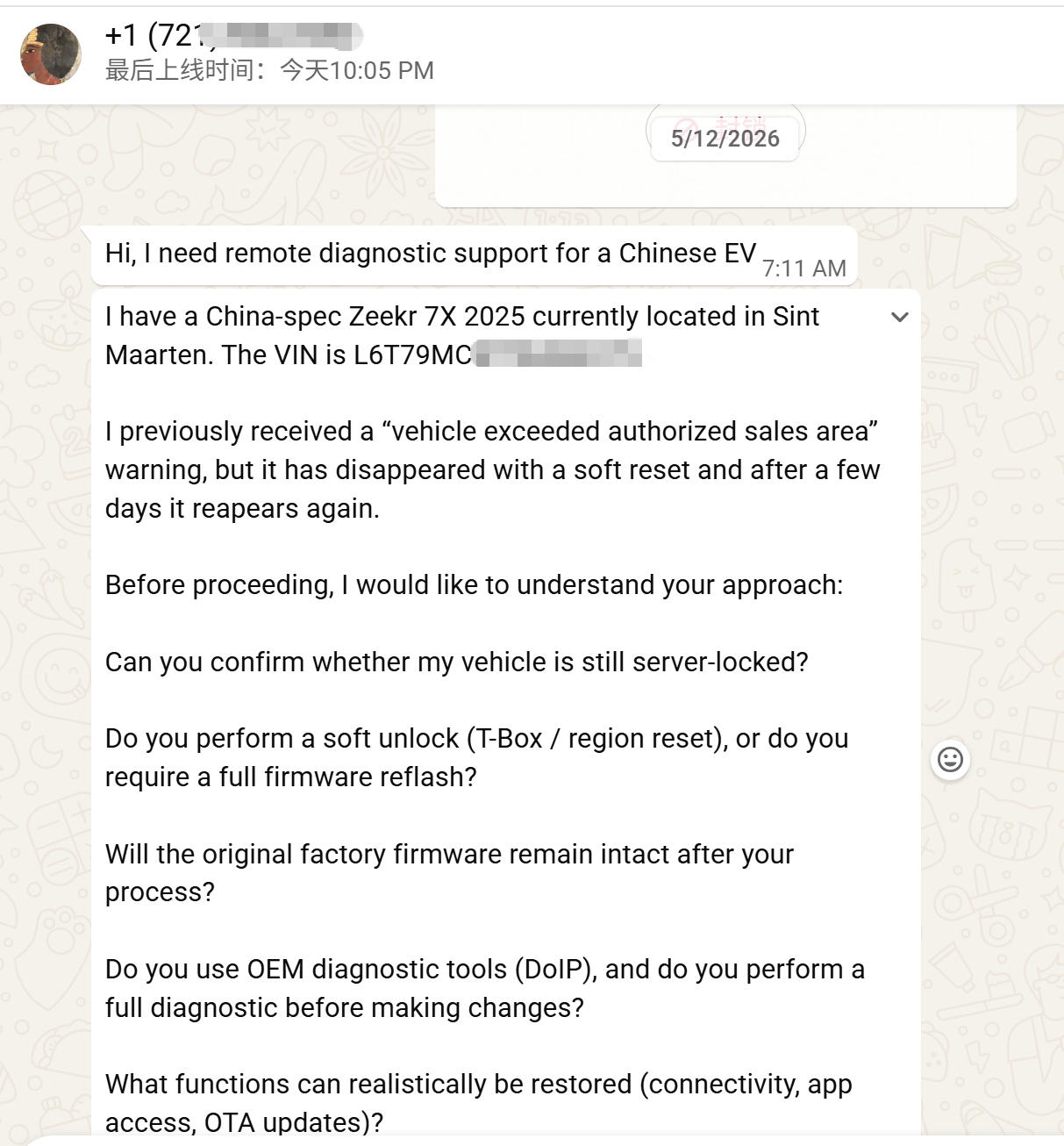
The original WhatsApp inquiry from the Sint Maarten workshop, June 2026. The client's questions covered the full diagnostic chain: symptom confirmation, soft-unlock feasibility, firmware integrity, and OEM tool compatibility — a model of what a well-prepared inquiry should look like.
Frequently Asked Questions
Why does my Chinese EV show "vehicle exceeded authorized sales area"?
This warning appears when a China-spec EV is operated outside mainland China for an extended period. The vehicle's T-Box communicates with the manufacturer's cloud servers, which periodically check GPS location against the authorized sales region. It is not a vehicle fault — it is an intentional server-side restriction that disables connectivity features, app access, and OTA updates when triggered.
Can a region-locked Chinese EV be unlocked without flashing firmware?
Yes. NEV Fix uses OEM unlock codes — vehicle-specific authorization strings tied to the VIN — entered directly on the infotainment system. This method does not modify the factory firmware, requires no flashing, and preserves all original vehicle functions. The restriction is permanently lifted at the server authorization level.
Is it safe to flash or upgrade a Chinese EV's Android infotainment remotely?
No — it is strongly discouraged. Chinese EV head units are deeply integrated with vehicle control modules (climate, driving modes, energy management). A failed or incompatible flash can brick the unit, leaving no access to critical vehicle functions. NEV Fix does not offer flashing services and recommends the safer OEM unlock code approach wherever a server-side authorization change can resolve the issue.
Will the region lock return after an OEM unlock code is applied?
No. The OEM unlock code permanently removes the regional authorization flag from the server-side record. Unlike temporary workarounds that clear the warning for a few days, this is a one-time, permanent solution that does not require reapplication regardless of where the vehicle is operated.
Does OEM unlock code application affect the vehicle's warranty?
The OEM unlock code does not modify firmware, software, or any vehicle module — it only changes a server-side authorization flag. The original factory firmware and all module data remain intact. However, it is important to note that most China-spec vehicles operated outside mainland China are already outside the manufacturer's domestic warranty coverage by the terms of the original sale. The unlock code process itself leaves no trace on the vehicle's hardware or software that would affect any warranty assessment.
Will OTA updates resume after the region lock is removed?
Yes — in virtually all cases, OTA functionality is restored after the region lock is removed. The OTA system relies on the same cloud connectivity path that the region lock disrupts. Once the server-side restriction is lifted, the vehicle can once again communicate normally with the manufacturer's update servers. The vehicle will then receive OTA updates as designed, as long as the T-Box hardware remains intact and the vehicle has an active data connection.
Related Cases & What We're Building
This Zeekr 7X case is the first in a series of documented case studies we are building. Each will cover a real overseas Chinese EV issue — with a specific vehicle, a specific problem, and a verified resolution path. Future installments will include:
BYD Region Lock
Coming soon
NIO Overseas Login
Coming soon
Xpeng Server Activation
Coming soon
Li Auto Cloud Auth
Coming soon
Chery Export Unlock
Coming soon
GAC Aion GCC Activation
Coming soon
📬 Have a case you'd like us to document? If you're a workshop or owner with a Chinese EV issue that we've helped resolve, let us know — we may feature it (anonymized) in a future case study. Contact via WhatsApp or Remote Support.
🔓 Have a region-locked Chinese EV?
Contact us with your VIN for a free eligibility check. Most China-spec EVs from BYD, Geely, Zeekr, Chery and other major manufacturers can be unlocked within 2 working days — no flashing required.
⚠️ We do not offer firmware flashing services. If your vehicle's problem can be solved with a server-side authorization change, we can help. If someone tells you to flash your Android head unit to fix a region lock — that is a red flag.