Home Remote Support Pricing Training FAQ Resources Parts Tech Blog About Us

Three Programmes, Booked Independently

Each programme is a standalone course with its own set of volumes. The complete 14-volume set is also available on its own.

Complete Syllabus

All 160 topics are listed below as they are taught, using the numbering of the source decks. Expand a volume to read its topics.

7-Day Complete EV Repair 8 volumes · 290 pages · 86 topics

01

Safety Knowledge and Emergency Skills

Refined edition: High-Voltage Safety and Emergency Response

29 pages · 14 topics

Read 14 pages free →
View 14 topics
  • 1.1 What is a high-voltage system — industry threshold and the human safety red line
  • 1.2 High-voltage versus traditional low-voltage power
  • 1.3 High-voltage components on an NEV
  • 1.4 Risk identification of high-voltage components
  • 1.5 Work-risk identification and preventive measures — shock, short circuit, mechanical
  • 1.6 Building safety awareness
  • 2.1 Insulated PPE — gloves, shoes, arc-flash face shield, insulated tools
  • 3.1 Why the power-down procedure must be followed — capacitor residual voltage
  • 3.2 Power-down flow and key steps on commercial vehicles
  • 3.3 Verifying the absence of hazardous voltage — Live–Dead–Live
  • Case analysis — insulation breakdown, leakage short circuit, real workshop accidents
  • 4.1 Scene safety and electric-shock first aid
  • 4.2 First-aid procedure
  • 4.3 CPR and use of an AED
02

Overview of New Energy Vehicles and Knowledge of Three-Electric Systems

70 pages · 12 topics

View 12 topics
  • I. Background and classification of new energy vehicles
  • II. Basic structure layout of a pure electric vehicle
  • III. The high-voltage battery — cell, module, pack, LFP vs NCM, voltage platform
  • III. High-voltage interlock (HVIL) — what it protects and how it is wired
  • III. Current measurement — Hall, closed-loop Hall, shunt
  • III. BDU and high-voltage contactors, including the pre-charge circuit
  • III. High-voltage distribution box
  • III. Vehicle control unit (VCU)
  • III. Drive motor and motor controller — PMSM, resolver, inverter
  • III. OBC on-board charger and DCDC converter
  • III. Charging port and power distribution
  • IV. Thermal management system — battery thermal management, PTC, three-way valve
03

Use of Testing Tools and Understanding of Charging Systems

46 pages · 16 topics

View 16 topics
  • 1.1 Instrument information — BYD K8 and GAC Aion clusters
  • 1.2–1.8 Warning lights — OK, turtle, powertrain, battery, motor overheat
  • 2.1–2.2 BMS basic functions and the five core tasks
  • 2.4 BMS key indicators and protection thresholds
  • 2.5 Power battery equalization
  • 2.6 BMS communication network
  • 3.2 Complete-vehicle diagnosis on a passenger car
  • 3.10 CATL battery diagnostic software — port, parameters, alarm codes, BMU detection
  • 3.11 Langren detector battery-pack test, and Aion original detector
  • 3.12 Integrated intelligent front-drive assembly calibration
  • 4.1 Megohm meter — specification and operation
  • 4.2 Digital multimeter — resistance and leakage-voltage measurement
  • 4.4 Battery health detector
  • 4.5 Air-tightness meter
  • 4.6 Equalizer — connection and use
  • 4.7 Balanced maintenance of battery cells
04

AC Charging Systems

20 pages · 12 topics

View 12 topics
  • 1.1 Characteristics of AC charging systems
  • 1.2 Core functions of the charging system
  • 2.1 Composition of the charging system
  • 2.2 Charging connection methods — case A, B and C
  • 2.3 Contact layout of the coupler
  • 2.4 Contact parameters and functions
  • 3.1 Charging connection interface and the protective circuit
  • 3.2 Principle of the AC charging circuit — C1, C2, relays
  • 3.3 Analysis of the AC charging process
  • 4.1 Visual inspection of the charging port
  • 4.2 Insulation testing — DC+ to PE, DC− to PE
  • 4.3 CC vehicle-side voltage detection
05

Working Principle and Fault Diagnosis of DC Charging Systems

35 pages · 19 topics

View 19 topics
  • 1.1 Characteristics of DC charging systems
  • 2.1 Composition of a DC charging system
  • 2.2 Connection function and contact layout
  • 2.4 Contact parameters and functions
  • 2.5 DC charging high-voltage and low-voltage control circuits (BYD EV)
  • 3.1 Overall charging process
  • 3.3 Charging control process — R1 to R5, CAN handshake, insulation test, discharge
  • 3.4 Charging circuit parameters
  • 4.1 Inspection items for the charging dock
  • 4.2 Insulation testing
  • 4.4 CC2 on-board resistance detection
  • 4.6 S+ and S− resistance detection
  • 5.1 Charging wake-up A+ fault
  • 5.2 Connection confirmation CC2 fault
  • 5.3 Charging socket temperature fault
  • 5.4 Voltage fault at the charging port
  • 5.5 "Charging gun not in place" message
  • 5.6 Sudden stop during charging
  • 5.7 Charging fault troubleshooting process
06

High-Voltage Interlock (HVIL)

29 pages · 3 topics

View 3 topics
  • I. Principle and definition of high-voltage interlock
  • II. Analysis of interlock circuits and components, loop by loop
  • III. Common faults — decoding, waveform monitoring, P0A0A01, series-loop break location
07

High-Voltage System Insulation

35 pages · 4 topics

View 4 topics
  • I. Definition of insulation failure — influencing factors, GB 19517-2023, fault symptoms
  • II. Measurement method of insulation resistance — megohm meter, HV harness, controller, motor, battery
  • III. Insulation repair method — harness, controller, motor, battery
  • IV. Troubleshooting and analysis of an insulation fault, end to end
08

HV Safety, Distribution and Charging System Repair

26 pages · 6 topics

View 6 topics
  • Risk awareness in NEV repair, and the specification for safe operation
  • The five-step depowering method, step by step
  • HV distribution system understanding and fault-diagnosis flow
  • Slow charging and the CC / CP signals at the charging port
  • Charging system failure case analysis
  • GAC NEV VCI — connection, full-vehicle scan, diagnostic report, live data stream

3-Day EV Battery Repair 3 volumes · 119 pages · 38 topics

09

Structure and Function of Power Batteries for Electric Passenger Vehicles

45 pages · 15 topics

View 15 topics
  • 1.1 Battery system architecture
  • 1.3 Vehicle hardware relationships
  • 1.4–1.5 AC and DC charging overview
  • 2.1 Battery compartment and protection rating
  • 2.3–2.5 Battery module (CTP) and the modular structure
  • 2.6 Battery parameters
  • 2.8 Operating voltage of a ternary lithium (NCM) battery
  • 2.9 Connection method for module cells
  • 2.10–2.12 High-voltage distribution box and its electrical schematic
  • 2.14 Thermal management system
  • 3.1–3.6 BMS, BMU, current sampling unit, battery monitoring unit
  • Cell testing — open-circuit voltage and internal resistance measurement
  • Calculating remaining capacity from open-circuit voltage
  • Cell capacity measurement — process requirements and testing
  • Cell capacity matching and grouping
10

BMS System Training

37 pages · 11 topics

View 11 topics
  • Power management circuit and sources of supply
  • Cell voltage, pack current, and the three current-sensor types
  • Temperature sampling — NTC thermistors
  • Isolation between the high-voltage pack and the low-voltage logic circuit
  • CAN bus — 120 Ω termination, three measurement methods, ID arbitration
  • Daisy-chain sampling communication
  • Main control unit — SOC, SOH, SOP estimation
  • SOC by open-circuit voltage, and the limits of that method
  • SOC interval constraints and cell-consistency constraints
  • BMS software calibration constraints
  • Fault interpretation — Level 1 to Level 3, thermal-runaway warning
11

New Energy Power Battery Maintenance Technology

Refined edition: Power Battery Maintenance Technology

37 pages · 12 topics

Read 20 pages free →
View 12 topics
  • 1. Significance of balanced maintenance
  • 1.2 Causes and effects of battery inconsistency
  • 1.4 Core value of balanced maintenance
  • 2. Safety operating practices for the equalizer
  • 3. Battery module maintenance process
  • 4. Charging and discharging capacity calculation, using the SOC–OCV table
  • 5. Setting equalization parameters — discharge and charge
  • 6. Failure case study
  • 7. Definition and core role of airtightness
  • 7.2 Analysis of common airtightness failure sites — the five locations
  • 8. Personal protective equipment for airtightness work
  • 9. Airtightness testing and maintenance process — parameter setting, judgement

3-Day EV A/C System Repair 3 volumes · 179 pages · 36 topics

12

Air Conditioning System Training

71 pages · 13 topics

View 13 topics
  • Overview of the A/C system and its safety standards
  • The refrigeration cycle, step by step
  • PTC heating and heat-pump heating
  • Battery thermal heating
  • Cooling and recirculation modes
  • Scroll compressor — principle and core components
  • System components — electric compressor, condenser, expansion valve, receiver, evaporator, pressure protection
  • Refrigerant recovery and leak detection — R134a versus the newer refrigerant, six-step workflow
  • Nitrogen pressure holding, fluorescent leak detection, three-step vacuum
  • Refrigerant and oil rules — no mixing, POE oil, charge by weight
  • Common fault diagnosis — reading the pressure gauges
  • Live data, pressure gauge and step-by-step diagnosis
  • Case studies — BYD Han, Neta V, GAC Aion Y
13

Electric Air Conditioning Compressor Maintenance

54 pages · 12 topics

View 12 topics
  • What the electric compressor does — cooling, heat pump, vehicle thermal management
  • External connectors — HV supply, LV supply, HVIL, LIN
  • Internal structure — PMSM, stator and coils, rotor, fixed and orbiting scroll, balance weight, gasket
  • Controller functions — power conversion and fault protection
  • PMSM working principle and the three-phase inverter main circuit
  • Six-step commutation analysis
  • Scroll plate working principle
  • Mechanical failures — scroll seizure and abnormal wear
  • Electrical failures — motor winding, HV terminal, HV connector insulation
  • Compressor maintenance procedure
  • Test bench — functions, safety specifications, operation steps, decibel test
  • Fault judgement, replacement strategy, pre-replacement inspection, post-replacement verification
14

Air Conditioning Communication and Signals

54 pages · 11 topics

View 11 topics
  • What A/C communication is, and why several types coexist
  • Digital and analog signals — NTC temperature sensors
  • LIN bus — single-wire, master and slave nodes
  • PWM signal
  • CAN bus — differential transmission, the 2.6 V / 2.4 V readings, three measurement methods
  • Non-destructive bitwise arbitration
  • Error detection and recovery
  • Heating in an NEV — PTC electric heating and heat-pump heating
  • Water-cooled PTC principle
  • Thermodynamic mechanism of the heat-pump system
  • Eight thermal-management modes, by ambient temperature and battery state

Preview the Training Manuals

Two of the fourteen volumes have been rebuilt as refined manuals. Read the opening pages in full, in the browser, without downloading anything.

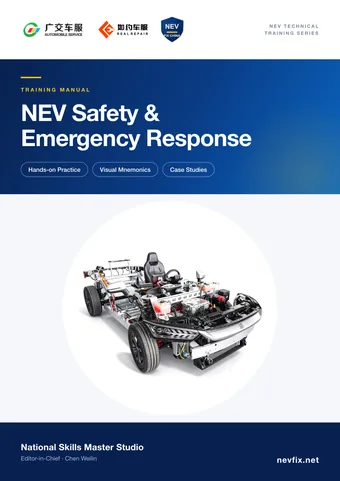
Cover of the NEV Fix training manual High-Voltage Safety and Emergency Response
Volume 01 · refined

High-Voltage Safety and Emergency Response

29-page refined edition of Safety Knowledge and Emergency Skills · high-voltage hazards, insulated PPE, power-down flow, Live–Dead–Live verification, first aid

Read pages 1–14 free

Open the sample
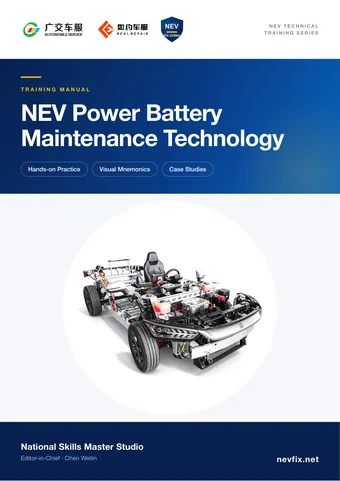
Cover of the NEV Fix training manual Power Battery Maintenance Technology
Volume 11 · refined

Power Battery Maintenance Technology

37-page refined edition of New Energy Power Battery Maintenance Technology · pack structure, balancing, capacity calculation, airtightness testing, module repair

Read pages 1–20 free

Open the sample

Get the Training Materials

Materials can be bought on their own, whether or not you attend a programme. Prices are quoted on request.

Complete Set — 14 PDF Volumes

The complete set contains the 14 PDF volumes used in NEV Fix's three on-site training programmes, covering 588 pages and 160 syllabus topics.

Two volumes have been rebuilt as refined PDF manuals and are also sold individually: Safety Knowledge and Emergency Skills (refined edition, 29 pages) and New Energy Power Battery Maintenance Technology (refined edition, 37 pages).

The remaining twelve are supplied in their original classroom editions and are not sold individually — they come with the complete set. The main instructional text is in English. Each volume opens with the bilingual foreword used across the series, and some diagrams and diagnostic screenshots retain Chinese labels from the original Chinese vehicle software.

Most pages contain selectable, searchable text. Some diagram and diagnostic screenshot pages are image-based and may not support text selection, keyword search or direct machine translation.

Usage Licence

The standard purchase licence covers personal learning and internal use within one workshop. It does not allow sending the files to other workshops, using them as paid teaching material for another organisation, or translating, adapting, republishing or reselling them.

Multi-site businesses require a separate written licence for use across multiple locations. Training institutions that wish to use the materials in paid training must also obtain a separate written institutional licence.

Neither licence automatically includes the right to translate, modify, adapt, redistribute or resell the materials. These rights require separate written permission from NEV Fix.

Credit Towards On-Site Training

If you buy materials first and enrol in an eligible NEV Fix on-site programme within 12 months, the amount paid for the materials is credited in full towards the course fee. The 12 months run from the date your payment is received. The credit cannot exceed the fee of the programme you book and cannot be exchanged for cash. It covers standard purchases only — institutional, adaptation and resale licences are not eligible. The credit is limited to the purchaser or the workshop named on the order and cannot be transferred to an unrelated person or business. Any unused balance is not carried forward to a later booking.

Both buttons open WhatsApp with a pre-filled message. You can also email cnwangs@163.com.

Questions About the Materials

Can I buy the materials without attending a course?

Yes. You can buy the complete 14-volume set, or either of the two refined volumes — high-voltage safety and power battery maintenance — without attending a programme. The other twelve volumes are not sold individually; they come with the complete set.

Are the materials in English?

The main instructional text is in English. Each volume includes the bilingual foreword used across the series. Some diagrams and diagnostic screenshots retain Chinese labels from the original Chinese vehicle software.

Are these PowerPoint files?

No. They are PDF files, not editable PowerPoint presentations, and source files are not included. The 7-day and battery materials are mainly A4 portrait pages; the A/C materials use a 16:9 landscape layout.

Which volumes do I receive if I attend?

Delegates receive the PDF volumes for the programme they attend: 8 volumes on the 7-day complete EV repair programme, 3 on the 3-day battery repair programme and 3 on the 3-day A/C system programme. The complete 14-volume set is also available separately.

Can a training institution use these materials for paid training?

Not under the standard licence, which covers personal learning and internal use within one workshop. Training institutions that wish to use the materials in paid training must obtain a separate written institutional licence from NEV Fix. That licence does not automatically include the right to translate, modify, adapt, redistribute or resell the materials — those rights require separate written permission.

Are all pages searchable and selectable?

Most pages contain selectable, searchable text. Some diagram and diagnostic screenshot pages are image-based and may not support text selection, keyword search or direct machine translation.

Can the cost of the materials be credited toward a course?

If you buy materials first and enrol in an eligible on-site programme within 12 months, the amount paid is credited in full towards the course fee. The 12 months run from the date payment is received. The credit cannot exceed that course fee and cannot be exchanged for cash. It covers standard purchases only and is limited to the purchaser or the workshop named on the order; it cannot be transferred to an unrelated person or business. Any unused balance is not carried forward to a later booking.

Learn It Hands-On

The materials show what we teach. The programmes are where the work happens: 30% theory, 70% on the bench, small groups, in Guangzhou.