Training Facility & Equipment
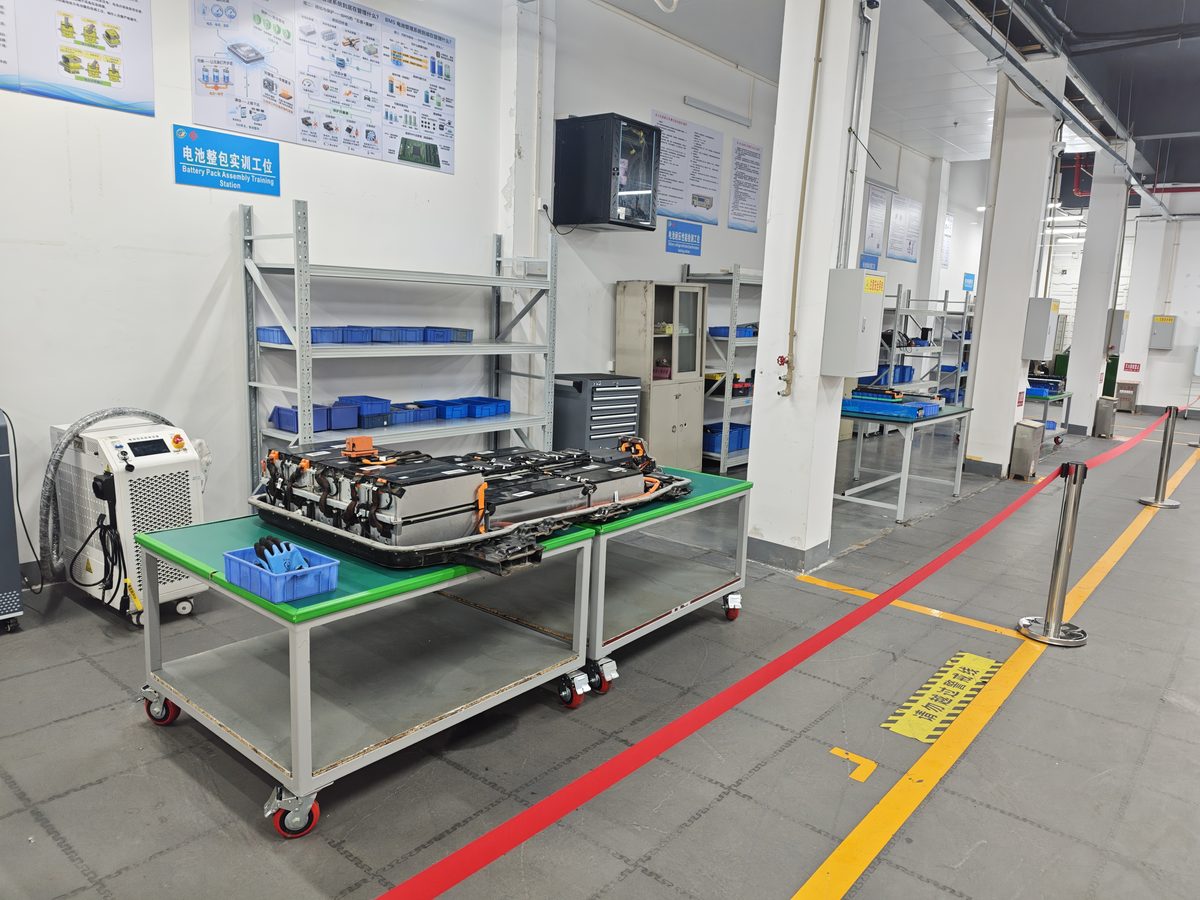
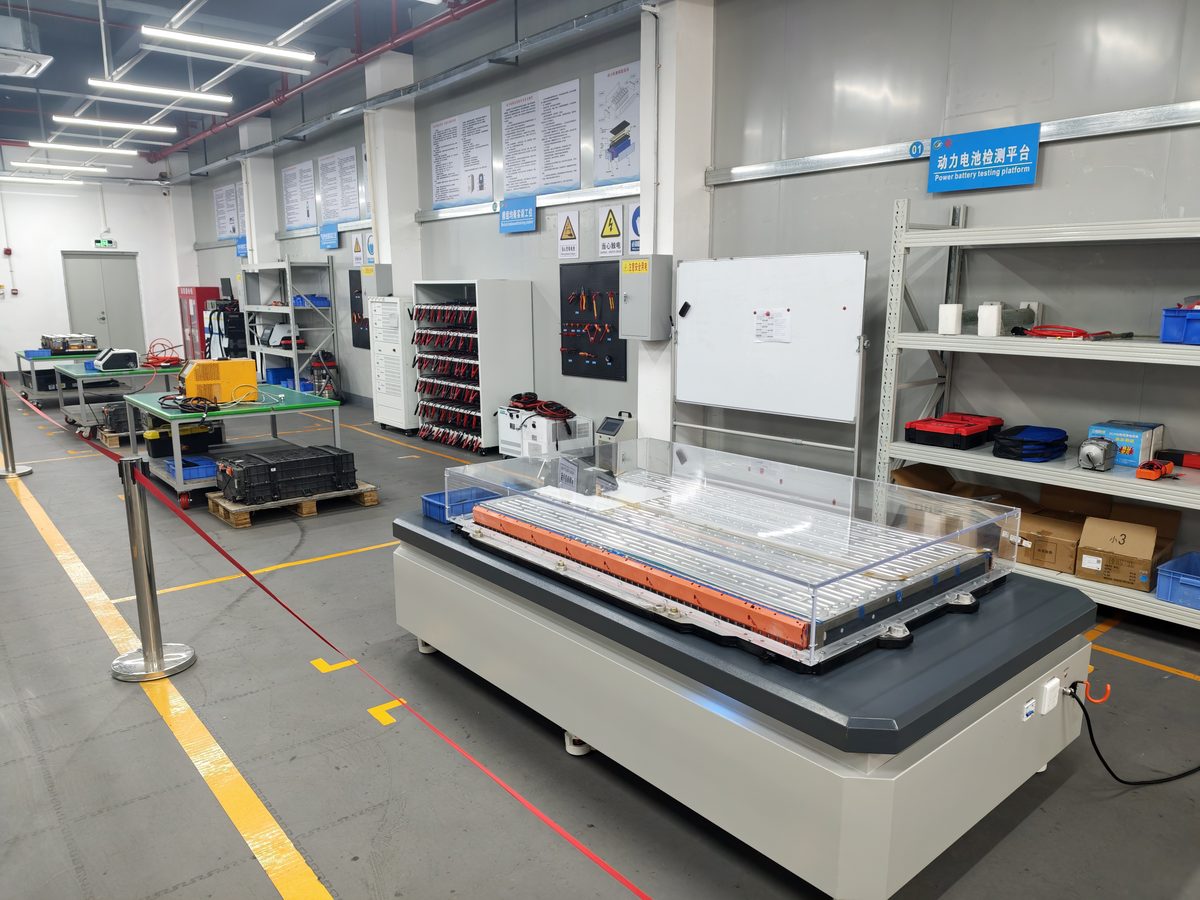
Real BYD battery packs · Professional testing platforms · Guangzhou training base
Click to enlarge
Click to enlarge
Hands-on BYD & CATL battery training for overseas technicians in Guangzhou · BMS diagnostics · Cell testing & grading · Module replacement · Joint certificate
A specialised 3-day hands-on programme focused exclusively on NEV power battery systems. Participants learn high-voltage safety procedures, BMS data interpretation, insulation fault diagnosis, battery pack opening and internal structure identification, cell testing and grading, module replacement, cell balancing, BMS board-level diagnostics, CAN bus message analysis, and SOH assessment — using real battery packs from BYD, CATL, and other mainstream manufacturers.
This course is designed for automotive technicians with prior repair experience who want to specialise in EV battery diagnostics and repair. It is ideal for workshops that already service Chinese EVs and need in-house battery repair capability, as well as technicians who have completed the 7-day complete training and want deeper battery-focused practice.
Not suitable for: Complete beginners with no automotive repair background. If you have never used a multimeter or worked on vehicle electrical systems, start with the 7-day complete course instead.
Battery faults are the most expensive and complex issue overseas workshops face with Chinese EVs
Most overseas workshops cannot diagnose or repair battery packs internally. Every battery-related fault means sending the vehicle to a dealer — costing time, money, and customer trust.
As Chinese EV volumes grow in CIS, Southeast Asia, and the Middle East, workshops that cannot handle battery repairs in-house will lose customers to competitors who can. Remote diagnostic support helps in the short term, but building in-house capability is the long-term answer.
You don't need 7 days to start repairing batteries. This focused programme teaches the specific skills you need — BMS diagnostics, cell replacement, balancing — in 3 intensive days using real packs.
Practical, job-ready skills — not theory exams
Read and interpret BMS diagnostic data — identify faulty cells, voltage deviations, and temperature anomalies
Perform HV power-down, insulation testing, and safety verification on battery packs
Open battery packs safely, test and grade individual cells, and identify which cells need replacement
Replace faulty modules with correct torque, polarity, and insulation procedures
Perform passive and active cell balancing to restore pack consistency
Diagnose BMS board-level faults — sensing harness, CAN transceiver, sampling IC failures
Capture and decode CAN bus messages using PCAN tools for advanced diagnostics
Follow the standard fault diagnosis workflow: Safety Check → DTC Read → Data Analysis → Localisation → Repair & Verification
Want to see what battery faults look like in real workshops? Read our technical case studies from overseas repair scenarios. Planning to open a battery repair shop? See our complete EV battery repair business guide with real costs, revenue scenarios, and safety requirements.
12 modules · 70% hands-on practice · Real battery packs and BMS systems
| Time | Module | Core Content | Format |
|---|---|---|---|
| 09:00–09:30 | Course Kick-off & Introduction | Course objectives overview, participant needs assessment, safety briefing & liability waiver signing | Lecture |
| 09:30–10:30 | Module 1: Advanced HV Safety & Operating Procedures | GB/T 38032-2021 safety specs · Standardized HV power-down, verification & discharge procedure · PPE inspection & donning/doffing · High-voltage work permit & two-person principle | Theory + Practical |
| 10:45–12:00 | Module 2: Power Battery System Architecture | Battery hierarchy (Cell → Module → Pack) · LFP vs NCM chemistry comparison · Pack internal layout: HV busbars, sensing harness, cooling · BMS hardware: master/slave boards, sampling & balancing circuits | Theory + Visual ID |
| 14:00–15:30 | Module 3: BMS Data Reading & Diagnostics | Diagnostic software setup & protocol configuration · Key data interpretation: total voltage, cell voltages, temperatures, SOC, SOH · Anomaly identification (voltage deviation >50mV, temp spread >5°C) · DTC reading, decoding & freeze frame analysis | Theory + Practical |
| 15:45–17:00 | Module 4: Insulation & Leak Testing | Insulation resistance testing principles (≥20 MΩ) · Segmented insulation fault diagnosis · Airtightness/leak testing standards · GB/T 45099 repair completion requirements overview | Theory + Practical |
| Time | Module | Core Content | Format |
|---|---|---|---|
| 09:00–10:00 | Module 5: Pack Lid Removal & Internal Structure | Pre-opening safety verification & HV power-down · Lid removal protocol & torque specs · Internal component identification: modules, HV busbars, harness, BMS slave boards, cooling lines · Anti-static & short-circuit prevention | Hands-on (Demo + Practice) |
| 10:15–12:00 | Module 6: Cell Testing & Grading | Cell OCV & internal resistance measurement · Consistency evaluation criteria (voltage, IR, capacity deviation) · Faulty cell identification & marking · Cell grading & matching principles | Theory + Practical |
| 14:00–15:30 | Module 7: Module Replacement & Repair | Module removal: disconnect HV busbars, remove sensing harness, detach mounting bolts · Lifting & handling safety · New module installation: polarity check, insulating tape, torque control (±5%) · Post-replacement functional verification | Hands-on (Demo + Practice) |
| 15:45–17:00 | Module 8: Cell Balancing Hands-on | Passive vs active balancing principles · Balancer parameter configuration & safe operation · Monitoring & fault handling during balancing · Post-balancing consistency verification (voltage deviation ≤20mV) | Theory + Practical |
| Time | Module | Core Content | Format |
|---|---|---|---|
| 09:00–10:15 | Module 9: BMS Board-Level Diagnostics | BMS main/slave board functional block diagram · Sensing harness fault diagnosis (open, short, poor contact) · BMS communication fault (CAN bus voltage, terminating resistor) · Common board faults: power IC, CAN transceiver, sampling IC failure | Theory + Practical |
| 10:30–12:00 | Module 10: CAN Bus & SOH Testing | CAN bus communication principles & message structure · BMS CAN message capture & decoding using PCAN · SOH assessment: capacity test, IR test, OCV curve analysis · Charge/discharge capacity testing procedures | Theory + Practical |
| 14:00–15:30 | Module 11: Comprehensive Fault Simulation | Team competition covering: insulation fault (leakage) · BMS communication failure · Cell voltage anomaly · Temperature sensor fault · HVIL circuit fault · Charging cut-off / communication timeout — Standard workflow: Safety Check → DTC Read → Data Stream Analysis → Fault Localisation → Repair & Verification | Team Competition |
| 15:45–16:30 | Module 12: Course Wrap-Up | Systematic review of 3-day core knowledge · Q&A and experience sharing | Lecture |
| 16:30–17:00 | Graduation Ceremony | Certificate presentation & group photo | — |
Real BYD battery packs · Professional testing platforms · Guangzhou training base
Certified NEV specialists from Guangzhou's public transport repair division
11 Certified NEV Specialists · 1 National Skill Master Workshop · 3 National Traffic Technology Experts · 4 Guangdong May 1 Labor Medalists
National Skill Master Workshop Lead
Senior NEV Technician · National May 1 Labor Medal · Expert in HV system safety and battery diagnostics
Battery Swap Specialist
Guangdong May 1 Labor Medal · Certified in battery pack repair and cell replacement procedures
Battery Swap Specialist
Guangdong May 1 Labor Medal · Specialised in BMS data analysis and cell balancing techniques
NEV Repair Standards Author
Co-author of "Guangzhou NEV Repair Service Guidelines" · National Traffic Technology Expert
Our full training team includes 11 certified specialists from Guangzhou's public transport NEV repair division — all holding national or provincial technician credentials.
Since launching this 3-day intensive, we have received enquiries from multiple countries
Workshop owner enquiring about BYD battery diagnostics capability
Technician seeking specialised battery pack repair training
EV service centre interested in Chinese battery system training
The Early Bird price point (¥6,000 with shared twin-room accommodation, breakfast & lunch included) combined with battery-focused specialisation has attracted interest from diverse markets — from Southeast Asia to Europe. For a real-world example of how Chinese EV battery systems behave in overseas workshops, see our BYD Sealion 07 Ukraine localization case study.
A focused, fast-track programme for technicians who need battery repair skills now.
Enrol NowUnsure which course fits your needs? The 3-day intensive focuses exclusively on battery pack diagnostics, module replacement, and BMS repair. The 7-day course covers the full vehicle — HV safety, drive motors, charging systems, CAN networks, and commercial vehicle EV systems.
| Criteria | 3-Day Battery Intensive | 7-Day Complete Course |
|---|---|---|
| Price | ¥6,000 / person (Early Bird) | ¥15,000 / person (Early Bird) |
| Duration | 3 days | 7 days |
| Focus | Battery pack + BMS only | Full vehicle (HV, motor, charging, CAN, battery, commercial) |
| Accommodation | Twin-share included | Twin-share included |
| Best For | Techs with auto repair experience wanting battery specialisation | Beginners and career switchers wanting full EV repair capability |
| Why this price? | Shorter duration, no accommodation — you only pay for battery-focused training | Full immersion: 7 days, twin-share accommodation, all major EV systems covered |
| Certificate | Joint certificate | Joint certificate |
🔧 Setting up a battery repair shop? We can source and ship the complete equipment package you trained on.
25-item verified package at ¥55,300. Global shipping in 30-45 days. No sourcing fees — prices include our margin.
See our Equipment Sourcing Service →This 3-day intensive course is designed for technicians with prior auto repair experience. Basic knowledge of electrical systems and high-voltage safety is helpful but not mandatory — Day 1 covers HV safety fundamentals before any hands-on work begins.
The course equips you with the skills to perform BMS diagnostics, insulation testing, cell testing and grading, module replacement, cell balancing, and comprehensive fault diagnosis. With proper tools and safety equipment, most graduates can handle common battery pack faults independently. Complex board-level repairs may require additional practice.
The training uses real battery packs and BMS systems from mainstream Chinese EV brands including BYD (LFP blade battery), CATL, and Gotion. Diagnostic procedures are applicable across brands that use similar BMS architectures.
The 3-day battery intensive focuses exclusively on power battery systems — HV safety, BMS diagnostics, pack repair, cell balancing, and fault diagnosis. The 7-day complete course covers the full vehicle: HV safety, drive motors, charging systems, commercial vehicle systems, CAN networks, and battery systems. The 3-day course is ideal for technicians who want to specialise in battery repair quickly.
Yes. The 3-day intensive course fee is CNY 6,000 per person (Early Bird, first 50 seats; standard price CNY 8,000 thereafter) and covers tuition, hands-on materials, English interpretation, digital materials, the joint certificate, shared twin-room accommodation, breakfast, and lunch. Dinner and local transportation are not included.
Battery repair intensive courses are scheduled monthly. Contact us via WhatsApp or email for the next available session date. Sessions are limited to 10 participants to ensure sufficient hands-on time with real battery packs.
Enrolment is simple: (1) Contact us via WhatsApp or email to confirm your preferred session date. (2) We will send you a course outline and payment details. (3) A deposit secures your seat, with the balance due before the course starts. We accept WeChat Pay, Alipay, USDT, and Visa.
This course is not suitable for complete beginners with no automotive repair background. If you have never used a multimeter, never worked on a vehicle's electrical system, or are not comfortable with high-voltage safety concepts, we recommend starting with the 7-day complete training course which builds foundational knowledge from Day 1.
To perform battery repairs independently, you will need: an insulation tester (megohmmeter, ≥1000V), a cell voltage/internal resistance tester, BMS diagnostic software (brand-specific or universal), a PCAN or similar CAN bus analyser, standard insulated hand tools (torque wrench, insulating gloves, HV mat), and access to replacement cells or modules. The course includes guidance on sourcing these tools — many are available through NEV Fix's parts network. For a complete breakdown of workshop setup costs and equipment tiers, see our 2026 EV workshop equipment budget guide (three tiers from ¥24,500 to ¥79,800). You can also search OE part numbers for specific replacement components.
Battery faults are the #1 reason overseas workshops send vehicles to dealerships. This 3-day course gives your team the skills to diagnose and repair battery packs in-house — saving time and reducing outsourcing costs.
Monthly intake · Max 10 per class · Early Bird ¥6,000 (standard ¥8,000)
📋 3-Step Enrolment:
1. WhatsApp us to confirm your preferred month
2. Receive course outline & payment details
3. Deposit secures your seat — balance due before course starts