⚠️ Quick Summary
A Li Auto authorized service center in Azerbaijan replaced the T-BOX module on a 2024 Li Auto L9 Ultra and simultaneously performed an OTA upgrade from vehicle software version 6.3 to 7.5. After the upgrade, the center screen displayed: "The LiDAR is still not working, and the 3D surrounding view is still missing." Basic vehicle functions remained normal, but all ADAS and surround-view features were gone.
Remote diagnosis from Guangzhou connected via Smartlink C gateway. The full-system topology scan showed widespread ECU communication failures. The critical finding came from the FSD domain: NVIDIA Orin 1 and Orin 2 chips both failed to boot (fault codes C188B47-09 and C188E47-09). Three separate software re-flashing attempts, including one after a full vehicle power cycle, all failed. Diagnosis: FSD module hardware-level corruption. Software recovery impossible.
Solution: A genuine new FSD module was sourced, programmed, and configured in Guangzhou, then shipped to Azerbaijan for local installation. The customer is awaiting delivery and final verification.
Key takeaway: This case demonstrates that highly integrated EV systems may require advanced diagnostic capability when OTA updates, module replacement, and ECU communication issues occur outside the original service network. Even authorized service centers cannot always recover an FSD module with hardware-level startup failure—and this case shows why overseas workshops need both remote diagnostic support and a reliable parts supply chain from China.
1. When a Simple T-BOX Replacement Becomes Anything But Simple
Chinese premium electric vehicles are reaching markets far beyond China. Models like the Li Auto L9 Ultra, with its NVIDIA Orin-powered autonomous driving system, LiDAR sensor suite, and over-the-air update capability, represent the cutting edge of automotive technology. But when things break outside China, the repair chain looks very different from what owners expect.
This case study documents a remote diagnosis performed for an overseas workshop in Azerbaijan. On the surface, the problem looked like a straightforward T-BOX (telematics box) module replacement. In reality, it was a multi-layered failure chain that exposed a critical vulnerability in the OTA update architecture of connected Chinese EVs.
What makes this case particularly instructive is that it did not end with a simple software fix. The diagnosis required distinguishing between three possible failure modes—coding error, software corruption, and hardware damage—using only remote tools from 6,000 kilometers away.
2. The Customer Problem: What the Workshop Saw
The vehicle was a 2024 Li Auto L9 Ultra, one of China''s most advanced plug-in hybrid SUVs. The owner brought it to a Li Auto authorized service center in Azerbaijan because the original T-BOX module was showing symptoms: SOS emergency call function was not working, and 4G connectivity was unreliable.
The service center performed two operations simultaneously:
- Hardware replacement: Swapped the old T-BOX module for a new one.
- Software upgrade: Performed an OTA firmware update from vehicle software version 6.3 to version 7.5.
After these operations, the vehicle''s basic functions worked normally. The infotainment system, 4G connectivity, and vehicle controls were all intact. But there was one glaring problem: the LiDAR sensor and 3D panoramic view were completely dead. No point cloud data, no obstacle recognition, no surround-view display.
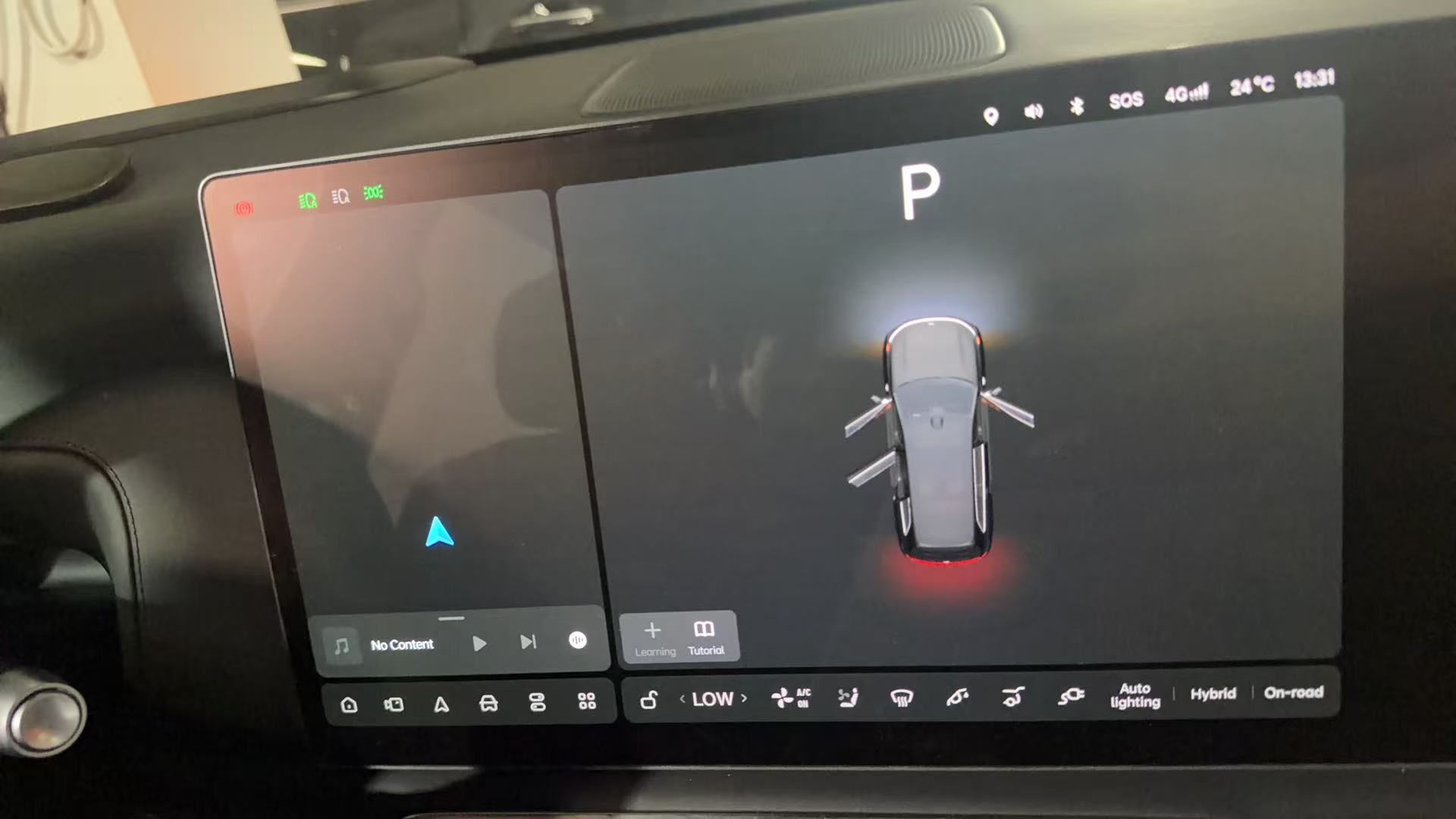
Fig. 1: The center display after the T-BOX replacement and OTA 6.3→7.5 upgrade. The system reports "The LiDAR is still not working, and the 3D surrounding view is still missing." No vehicle perimeter visualization at all.
The workshop reached out to NEV Fix with a straightforward question: "We replaced the T-BOX and now the LiDAR won''t work. Can you help us figure out what went wrong?"
3. The Real Cause: It Was Never the T-BOX
This is where the diagnostic challenge becomes interesting. When a system fails immediately after replacing a specific module, the natural assumption is that the replacement caused the failure. In this case, however, the initial hypothesis was wrong.
The Guangzhou-based technical team''s investigation revealed a different chain of events. The T-BOX replacement itself was successful—VIN coding was written correctly, and the telematics module was communicating properly with the vehicle network. The investigation indicated that the failure was related to the OTA 6.3 to 7.5 firmware upgrade performed at the same time, rather than the T-BOX replacement itself.
The diagnostic data pointed to the FSD (Full Self-Driving) module—a separate domain controller powered by dual NVIDIA Orin chips—as the affected component. Both Orin 1 and Orin 2 chips failed to complete their boot sequence after the firmware was written. In the words of the Li Auto engineering team who reviewed the remote diagnostic logs: "An error occurred during the FSD module upgrade from version 6.3 to 7.5. The previous remote scan result of the T-BOX FSD module showed obvious abnormalities."
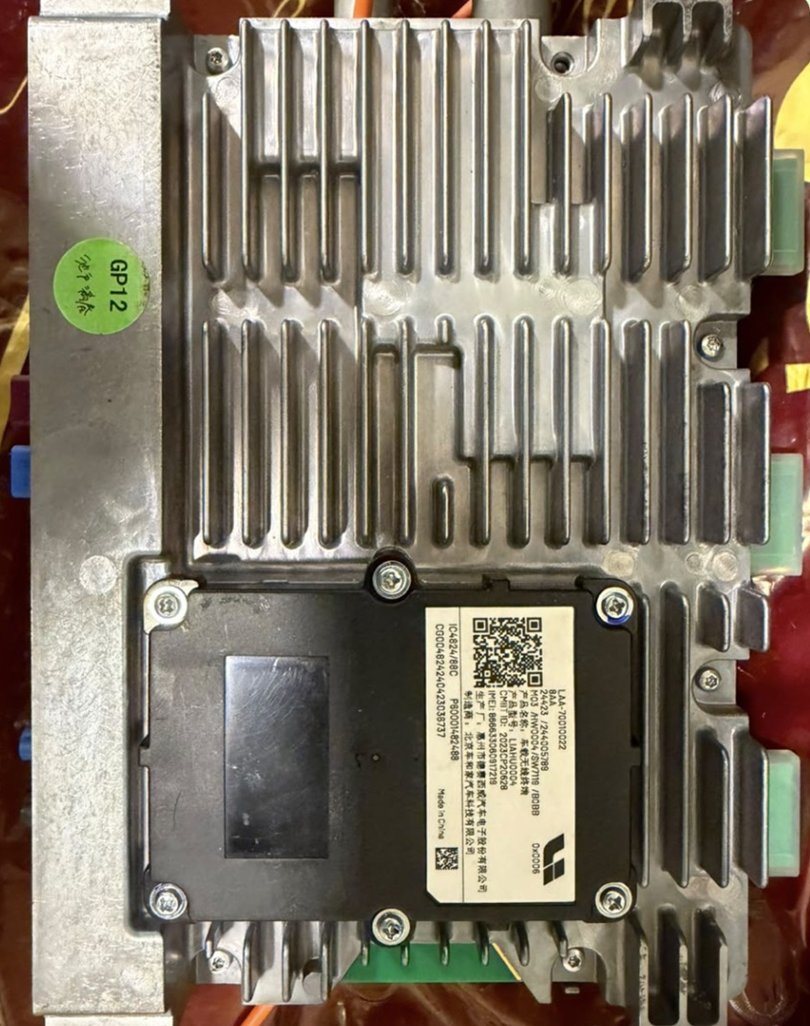
Fig. 2: The original T-BOX (telematics box) module that was replaced at the authorized service center. The T-BOX replacement itself was successful—VIN coding written correctly, telematics communication confirmed normal. The FSD failure was caused by the concurrent OTA 6.3 to 7.5 upgrade, not the T-BOX swap.
💡 Diagnostic Insight: The T-BOX and FSD systems are separate modules, but both participate in vehicle network communication and configuration processes. When the OTA upgrade affected the FSD module''s boot sequence, the LiDAR system—which depends on the FSD module for sensor fusion processing—became unresponsive. The T-BOX replacement was merely coincidental, and the diagnostic team''s ability to distinguish between the two was the key to avoiding unnecessary T-BOX re-replacement.
4. Remote Diagnostic Process: 4 Steps to a Hardware Verdict
The remote diagnosis was conducted on June 30, 2026. Using a direct ENET cable connection (via USB-to-Ethernet adapter) to the vehicle OBD-II port in Azerbaijan, engineers in Guangzhou established a real-time remote diagnostic tunnel for systematic, four-step analysis. Here is the timeline:
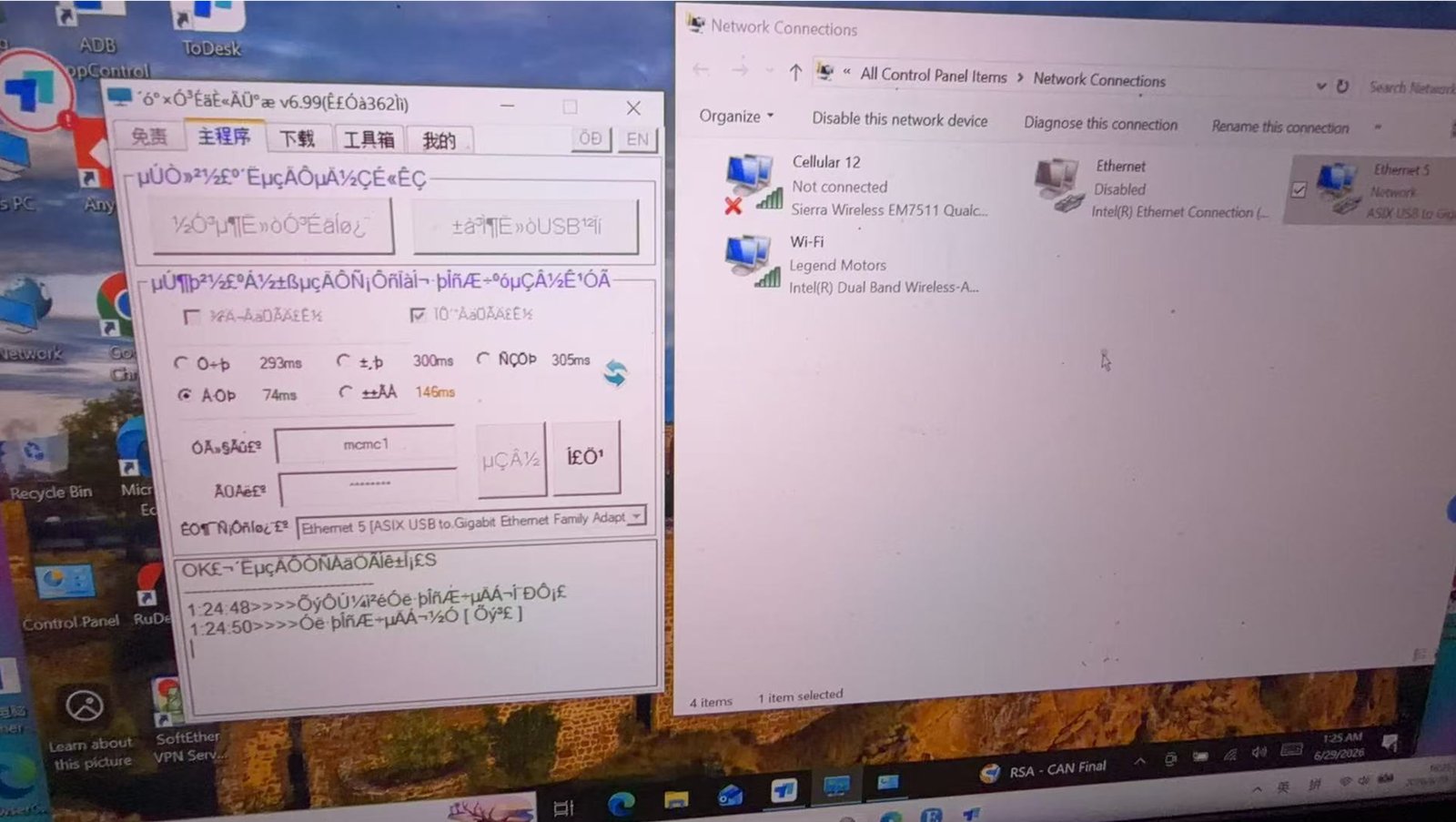
Fig. 5: Remote diagnostic setup using ENET cable (USB-to-Ethernet adapter) and OEM diagnostic platform. The Guangzhou-based NEV Fix engineering team connected directly to the Li Auto L9 in Azerbaijan over the internet for real-time fault code analysis. Latency readings (293ms/300ms/305ms/146ms) show network stability during the remote session.
- Remote connection established. T-BOX module confirmed successfully programmed. VIN coding verified. Telematics communication with vehicle network confirmed normal.
-
A complete vehicle network topology scan was performed. The results showed widespread communication failures across multiple ECU domains: MCUR (rear motor controller), ACU (airbag), ESP (electronic stability), IBOOSTER, ASU (air suspension), HU (infotainment domain), AMP (audio amplifier), and FSD (autonomous driving unit) all displayed red status indicators. This was not a single-module problem—it pointed to a central communication hub failure.
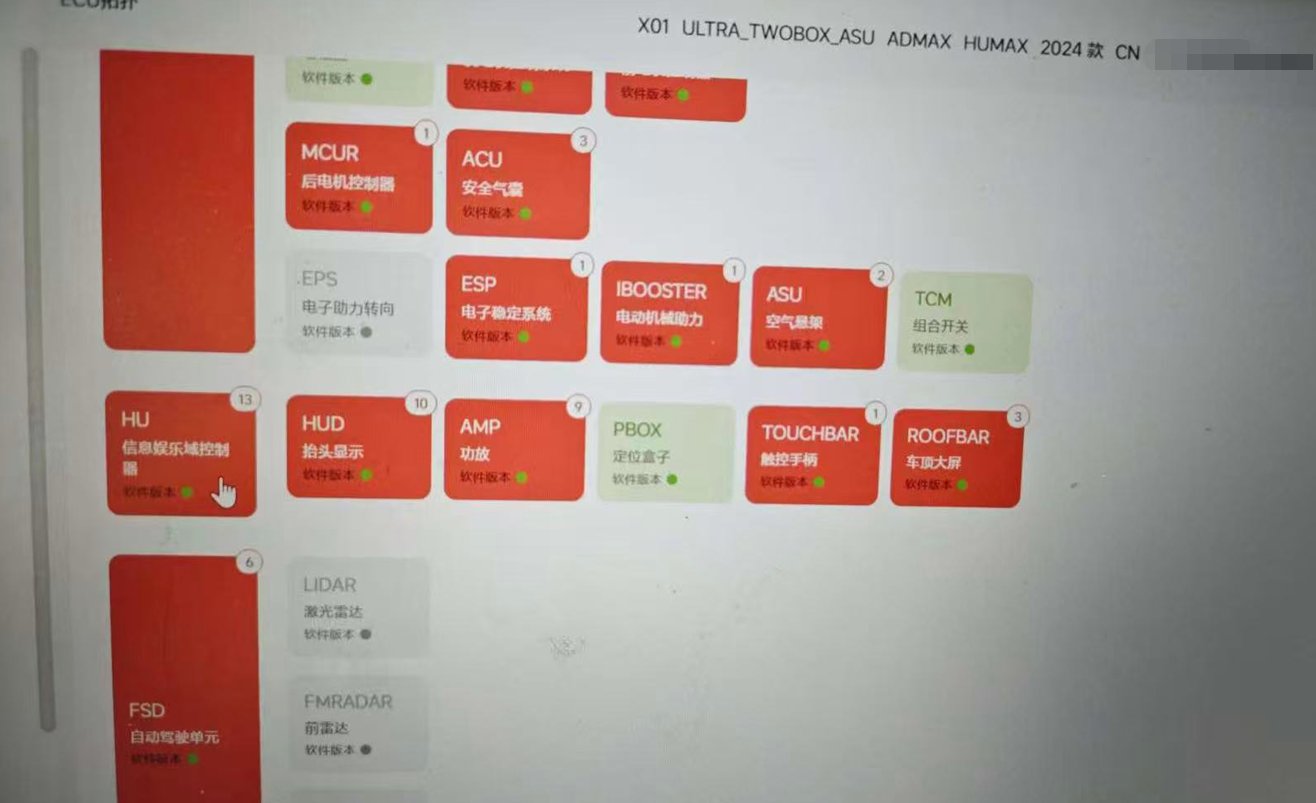
Fig. 3: Full-system topology scan showing multiple ECU communication failures (red status indicators). The pattern of failures pointed to a central gateway/hub issue rather than isolated module faults.
Connected to FSD domain controller. Immediately detected abnormal boot status on both Orin 1 and Orin 2 chips. FSD module was not responding to standard diagnostic queries. Initial attempt to read module status returned error codes indicating chip initialization failure. -
Attempted full firmware re-flash of the FSD module. Flashing progressed to approximately 50% completion, then stalled. A second attempt was made after a vehicle power cycle (total power cut for 10 minutes, as recommended by OEM protocol). Flashing completed on the second attempt, but the Orin chips still failed to boot.
The specific fault codes retrieved from the FSD domain were decisive:
- C188B47-09 — Orin_1 startup abnormality (Active Fault)
- C188E47-09 — Orin_2 startup abnormality (Active Fault)
- U024587-08 — Ultrasonic radar controller node lost (FSD2)
- U024587-08 — HU node lost (FSD1)
- U0075B7-2F — ADAS diagnostic fault (FMRADAR domain)
- U007532-09 — Time synchronization error (PAS domain)
The FMRADAR domain separately flagged
U0075B7-2F(ADAS diagnostic fault) andU0245B7-28(HU diagnostic fault), while the PAS (Park Assist System) domain independently reportedU007532-09(time synchronization error). These cross-domain fault patterns are a strong diagnostic signal: when multiple domains report communication and sync failures simultaneously, the root cause is almost never an individual ECU—it is the central gateway or network hub that all modules depend on.Significantly, the OEM diagnostic software''s own repair recommendation sequence told the same story: check bus state → check harness → check HU → replace HU → recheck bus state. This sequence points directly to a gateway/communication hub failure. In the Li Auto L9 architecture, the T-BOX module serves as the central communication gateway between telematics, infotainment, and ADAS domains. When the T-BOX was replaced and the OTA upgrade corrupted the FSD module''s bootloader, the result was a cascading communication breakdown visible across all connected ECUs.
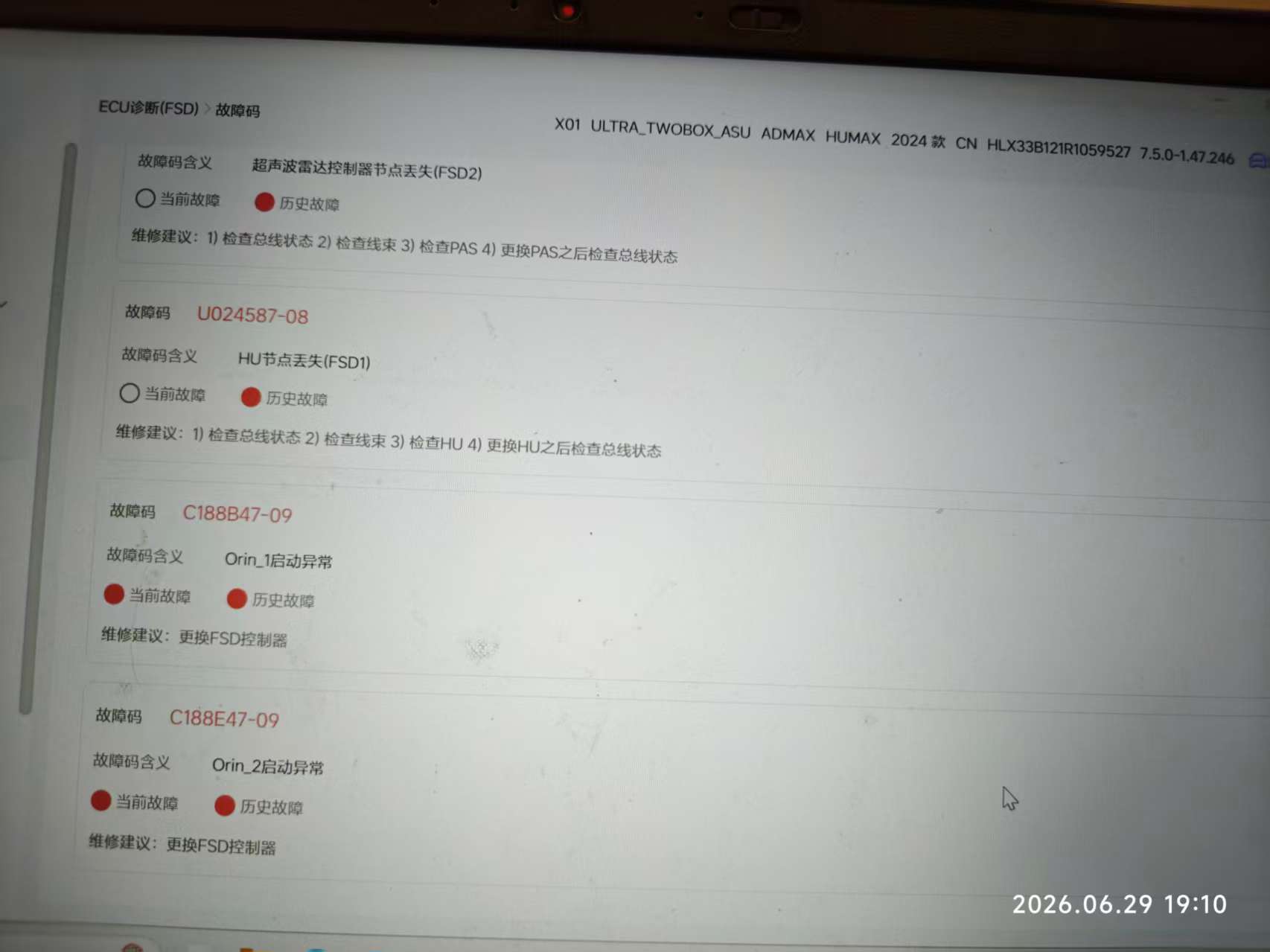
Fig. 4: FSD domain fault codes from the diagnostic scan. The two Orin chip startup abnormality codes (C188B47-09 and C188E47-09) were the decisive evidence: both NVIDIA Orin SoCs could not complete boot initialization. Multiple restart attempts were unsuccessful. This is a hardware-level failure of the FSD compute module.
- A third and final re-flashing attempt was made targeting Orin 1 and Orin 2 individually. Both chips refused to initialize. The engineering diagnosis was definitive: "The FSD module has hardware-level damage. Software recovery is not possible. The module must be replaced."
- T-BOX module confirmed fully operational. All non-ADAS vehicle functions verified normal. Safety assessment confirmed: vehicle safe to drive without FSD module.
On the following day (July 1), a second remote session was initiated to make one final software recovery attempt. The result was the same: the Orin chips could not boot. The hardware diagnosis was confirmed.
5. Why OTA Upgrades Can Cause Module Startup Failure: A Technical Perspective
Over-the-air firmware updates are one of the defining features of modern Chinese EVs. Manufacturers can fix bugs, improve performance, and add features without requiring a service visit. However, this case illustrates a less-discussed reality: OTA upgrades are not risk-free, especially for safety-critical domain controllers like the FSD module.
There are several reasons why an OTA upgrade can corrupt a module at the hardware level:
| Failure Mode | What Happens | Recoverable? |
|---|---|---|
| Bootloader corruption | The firmware writing process interrupts during bootloader update, leaving the chip unable to start its boot sequence. | ❌ Requires hardware replacement |
| Configuration mismatch | New firmware expects configuration data from a different vehicle variant, causing a validation failure on startup. | ✅ Can be fixed by re-writing correct configuration data |
| Flash memory wear | Repeated OTA updates over years degrade NAND flash cells. A write during an already-weakened state can cause permanent sector failure. | ❌ Requires hardware replacement |
| Power interruption | If the vehicle''s 12V battery voltage drops below a critical threshold during flashing, the incomplete write can permanently corrupt the firmware image. | Sometimes recoverable, often not |
| Checksum/CRC mismatch | The firmware package downloaded over the air contains a corrupted checksum. The module flashes the bad data anyway, but fails the post-flash integrity check. | ✅ Re-flash with verified firmware package |
In this case, the most likely failure mode was bootloader corruption. The fact that both Orin 1 and Orin 2 chips could not boot after flashing, and that multiple re-flashing attempts failed, strongly indicates that the initial OTA write corrupted the boot sector at a low level.
🚨 For Overseas Workshop Owners: If you service Chinese EVs and a customer reports that an ADAS system stopped working after a dealership visit, always ask whether any OTA upgrades were performed. The coincidence of "T-BOX replaced + ADAS dead" makes it easy to blame the wrong module.
6. The Solution: Module Replacement and Cross-Border Logistics
Once the hardware failure was confirmed, the path forward was clear:
- FSD module replacement. Software recovery was exhausted. A genuine new FSD module was the only viable solution.
- Safe to drive. The engineering team confirmed that the vehicle was safe to operate without the FSD module. Basic driving functions (steering, braking, acceleration) are handled by separate ECUs that were not affected.
- Parts procurement from NEV Fix. The customer ordered a genuine new FSD module from NEV Fix in Guangzhou. The module was sourced from Li Auto''s supply chain, programmed, VIN-coded, and fully configured before shipment — ready for plug-and-play installation upon arrival in Azerbaijan.
- Cross-border delivery. The pre-configured module was shipped to Azerbaijan through the customer''s logistics channel. Upon arrival, the local workshop will perform the physical swap and final verification, with NEV Fix engineers available for remote support during installation.
This case demonstrates the full service chain that overseas workshops need when repairing Chinese premium EVs: remote diagnosis to identify the problem with precision, genuine parts procurement with pre-configuration from China, and logistics support to get the right part to the right place — anywhere in the world.
7. What Overseas Workshops Should Learn From This Case
Module Replacement Is Not Just VIN Coding
Many workshops believe that swapping a module and writing the VIN is sufficient. On advanced Chinese EVs, modules also require configuration data, ADAS parameter matching, and security authentication—all of which can be corrupted during an OTA upgrade.
OTA Upgrades Carry Real Hardware Risks
OTA is not a harmless "software update." For domain controllers with bootloaders, a failed write can physically brick the module. Even authorized service centers cannot always recover from this without a hardware swap.
Remote Diagnosis Saves Trial-and-Error
Without remote diagnostic tools, the workshop might have spent weeks trying different T-BOX modules, assuming the LiDAR problem was caused by the T-BOX replacement. Remote diagnosis identified the real cause in hours.
Always Distinguish Software vs. Hardware Failure
The most valuable engineering judgment in this case was not "we fixed it," but rather "we confirmed this cannot be fixed with software." This prevents wasted time on re-flashing attempts and moves directly to the correct hardware solution.
8. Why This Case Matters for Overseas Chinese EV Repair Workshops
This case is not just about one Li Auto L9 in Azerbaijan. It reveals three shifts that every overseas workshop servicing Chinese EVs needs to prepare for:
Modern Chinese EV Problems Are No Longer Mechanical Only
ADAS controllers, telematics gateways, and OTA-capable domain controllers mean that a "simple repair" can cascade into multi-module issues. Workshops that only invest in mechanical tools will be unable to diagnose the most common problems on premium Chinese EVs manufactured after 2023.
Replacing Modules Without Proper Diagnosis Creates Unnecessary Costs
The initial assumption—"T-BOX replacement caused LiDAR failure"—was wrong. If the workshop had ordered another T-BOX module, they would have wasted US$500+ and still had a dead LiDAR system. Remote diagnosis prevented that mistake in hours, not weeks.
Overseas Workshops Need Three Capabilities for Chinese EVs
① Remote diagnostic support — engineers who know the vehicle platform and can connect remotely to read fault codes, analyze ECU status, and determine whether the problem is software or hardware. ② OEM module sourcing — access to genuine parts with pre-programming and VIN configuration before shipping. ③ Programming and configuration support — many Chinese EV modules cannot simply be plugged in; they require security authentication, parameter writing, and domain controller synchronization.
As Chinese EV brands expand into global markets at an accelerating pace, overseas workshops increasingly need direct technical support from China — not just parts, but diagnostic expertise, platform-specific knowledge, and real-time remote troubleshooting capability.
This is exactly the service chain that NEV Fix provides for overseas workshops. Whether the vehicle is a Li Auto, BYD, Zeekr, NIO, or AITO, the same three capabilities determine whether a repair is profitable or becomes a parked car that nobody can fix.
📡 Need Help Diagnosing Chinese EV Problems Overseas?
NEV Fix provides a complete support chain for overseas workshops repairing Chinese EVs: remote diagnosis by factory-trained engineers, genuine OEM module sourcing with pre-programming, and cross-border logistics support. Li Auto, BYD, Zeekr, NIO, AITO, Geely, Chery — if it came from China, our team of 50+ experienced EV engineers can help.
Frequently Asked Questions
Why does LiDAR stop working after replacing a Li Auto T-BOX module?
LiDAR failure after T-BOX replacement is often not caused by the T-BOX itself. In many cases, it results from an OTA firmware upgrade performed simultaneously that corrupts the FSD module configuration or memory. The ADAS domain controller and T-BOX share communication authentication data, and any mismatch or corruption can disable sensor systems. Always check whether an OTA upgrade was performed at the same time.
What happens when a Li Auto FSD module fails after an OTA upgrade?
When an FSD module fails after an OTA upgrade, the Orin 1 and/or Orin 2 chips may fail to boot. Symptoms include missing LiDAR point cloud data, blank 3D panoramic view, and ADAS fault codes. Software re-flashing may recover the module if the failure is software-level, but if the chip fails to initialize after re-flashing, the module has sustained hardware-level damage and requires replacement.
Can Chinese EV ADAS modules be programmed remotely?
Yes. Using remote diagnostic gateways such as Smartlink C, experienced engineers can connect to the vehicle over the internet to perform module programming, VIN coding, configuration data writing, and firmware flashing. However, hardware-level failures cannot be fixed remotely and require physical module replacement.
Can I drive a Li Auto L9 with a failed FSD module?
Yes. When only the FSD/ADAS module is affected, the vehicle remains safe to drive because basic driving functions (steering, braking, acceleration) are handled by separate vehicle control units. However, all ADAS features including adaptive cruise control, lane keeping, automatic emergency braking, LiDAR obstacle detection, and 3D surround view will be unavailable until the module is replaced. In this case study, a Li Auto L9 in Azerbaijan was driven normally for weeks while awaiting the replacement FSD module shipment from NEV Fix in China.
How can overseas workshops repair Li Auto vehicles outside China?
Overseas workshops typically need three capabilities to service Chinese EVs like Li Auto: ① remote diagnostic support from engineers familiar with the vehicle platform, ② OEM-level programming and configuration tools to handle VIN coding, security authentication, and module parameter writing, and ③ access to genuine replacement modules with pre-programming before shipment. Without these three, even a simple module swap can become a multi-week troubleshooting exercise with no guarantee of success.
How much does a Li Auto L9 FSD module replacement cost?
The cost varies depending on whether you use a genuine new module or a used module, and whether programming and configuration services are included. Genuine new modules with programming and full configuration support are more expensive but come with a guarantee. Contact NEV Fix for a current quote based on your specific situation and location.
Can Li Auto L9 ADAS or LiDAR faults be diagnosed remotely from overseas?
Yes. Using remote diagnostic gateways such as Smartlink C, experienced engineers can connect to the vehicle over the internet regardless of location. They can read fault codes from the FSD domain controller, check Orin chip status, perform full-system topology scans, and determine whether the problem is software-related (recoverable via re-flashing) or hardware-related (requiring module replacement). This capability eliminates expensive trial-and-error part swapping and provides a definitive diagnosis before any parts are ordered.
Can a failed FSD module be repaired without replacement?
It depends on the failure type. If the failure is software-level — such as corrupted configuration data or an incomplete firmware write — re-flashing the module with the correct firmware and configuration may recover it. However, if the Orin chip bootloader is corrupted or the chip fails to initialize after multiple re-flashing attempts (as in this Li Auto L9 case), the module has hardware-level damage and must be replaced. A proper remote diagnosis can distinguish between the two scenarios before time and money are spent on unsuccessful recovery attempts.
Related Case Studies & Resources
- Zeekr 7X Region Lock Unlock: A Remote Diagnostic Case Study — How we removed region-lock restrictions on a Zeekr exported outside China.
- Chery SGW Access: A Diagnostic Strategy Case Study — How to navigate security gateway restrictions on newer Chery models.
- How to Evaluate Chinese EV Training Programs: 5 Criteria for Workshop Owners — What to look for before investing in EV repair training.
- NEV Fix Training Programs — Hands-on training for overseas workshops on Chinese EV diagnostics and repair.
- EV Workshop Equipment Sourcing — Complete diagnostic toolkits and battery repair equipment for overseas workshops building Chinese EV repair capability.
- Remote Diagnostic Support Services — How our remote support works for workshops worldwide.