A workshop owner in Russia opened a remote support request with NEV Fix in September 2026 for a vehicle that was, on paper, almost new — a 2025 GAC Trumpchi S7, GAC Motor's 1.5T hybrid SUV, with barely four thousand kilometres on the odometer — but which had started behaving in ways no single fault seemed to explain.
The symptoms arrived in clusters. Some appeared and vanished within seconds. Others persisted for days. None of them pointed to an obvious failed component, and that is exactly the kind of case where guessing gets expensive.
This article documents what the diagnostic scan actually found, how those findings lined up with what the driver had been reporting, and what overseas workshops can take away from the process.
🛑 What Happened to the GAC Trumpchi S7?
According to the workshop's submission, the vehicle had undergone an OTA software update and Russian-language localization shortly after purchase. The symptoms reported afterwards included:
- Fuel filler flap errors — the vehicle repeatedly asked for the flap to be closed, and kept trying to retract it even when it was already shut.
- CarPlay dropping out — the phone connection disconnected roughly every five minutes.
- Slow AC charging reported on a daily basis.
- A powertrain error during DC fast charging that cleared about two hours later.
- Unexpected deceleration on the highway — the vehicle dropped from roughly 150 km/h to 100 km/h by itself, with the warning clearing after about ten seconds.
- Front safety system faults, appearing and disappearing around three times.
- The head-up display disappeared, with projection and speed instead shown as an overlay on the smaller screen. It recovered after a restart.
- The vehicle was found running with headlights on while locked, and only shut down when the key was brought close.
- A persistent bubbling sound from under the bonnet at low speed and at traffic lights.
Read as a list, this looks like nine unrelated problems. A workshop under time pressure would reasonably start replacing modules — and probably start with the head unit, given that the trouble began after software work.
Why this case is worth documenting: the workshop did not replace any hardware. The diagnostic data was read first, and the repair decision was made from that data rather than from the most visible symptom.
🔌 How the Workshop Connected the Vehicle for Remote Diagnosis
The remote session used the manufacturer diagnostic environment — GAC GIDS — run from a laptop at the Russian workshop, with NEV Fix guiding the session remotely.
The physical connection was the first practical hurdle. For this vehicle, the diagnostic link was established over DOIP (Diagnostic over IP) using an ENET Ethernet diagnostic cable. The workshop already had the cable and a Smartlink-C interface on hand, which removed the usual delay of shipping hardware before work can start.
One detail that cost time on the day: other devices were initially left connected to the vehicle. The instruction was to disconnect everything and leave only the OBD/DOIP cable attached. Once that was done, the session proceeded normally.
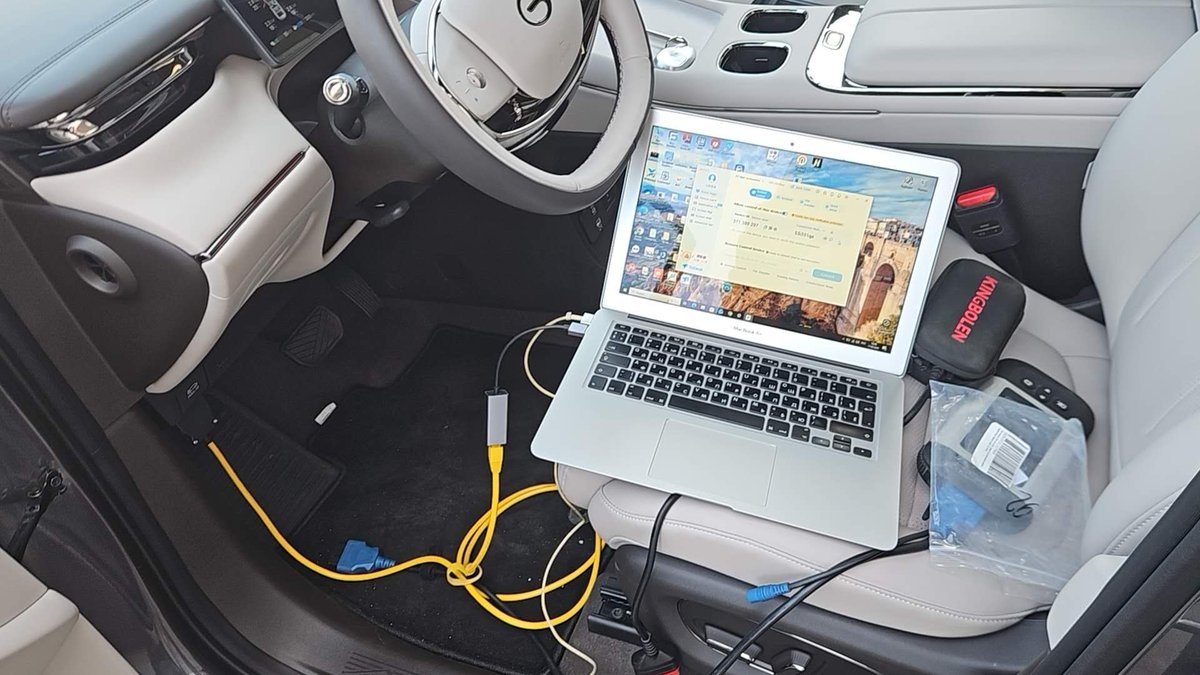
The remote diagnostic setup inside the Trumpchi S7: laptop on the passenger seat, ENET cable connected to the OBD port.
| Parameter | Value |
|---|---|
| Vehicle | GAC Trumpchi S7 |
| Model year | 2025 |
| Powertrain | 1.5T hybrid, four-wheel drive |
| Mileage | 4,279 km (per diagnostic report)* |
| Battery voltage | 14.0 V |
| Diagnostic software | GAC GIDS |
| Connection | DOIP / Ethernet (ENET cable) |
| Total fault codes | 33 (stored / historical) |
| Current faults | 0 |
| ECUs with stored faults | 16 |
* The diagnostic report recorded 4,279 km. The initial customer description mentioned approximately 3,700 km. The report figure is used here as the instrumented reading.
📊 What the Diagnostic Scan Found: 33 Stored Codes, Zero Current Faults
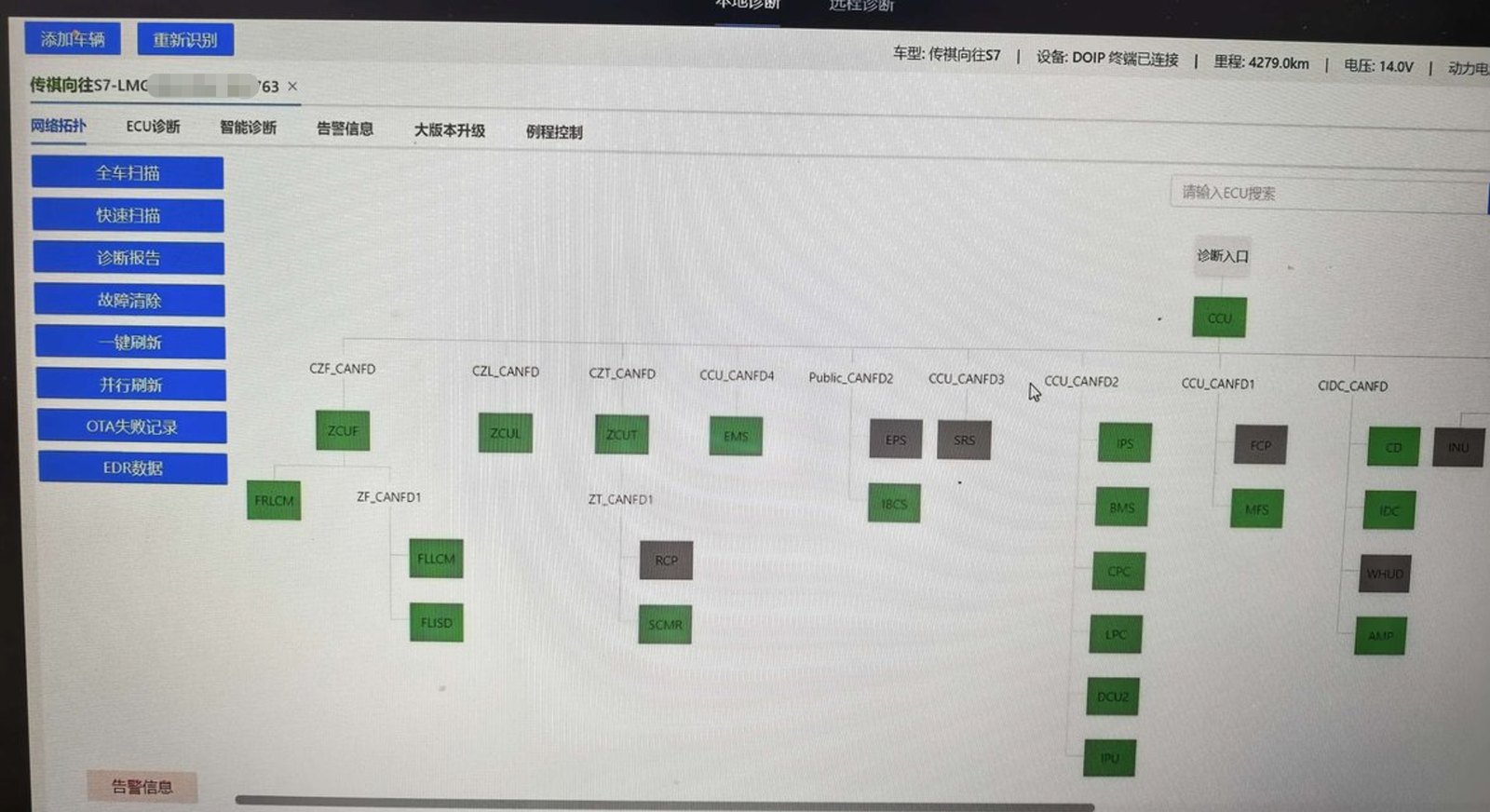
GAC GIDS diagnostic scan during the remote session: the report recorded 33 stored fault codes and listed six ECUs that could not establish communication.
The scan returned 33 fault codes across 16 ECUs. Critically, all 33 were stored historical faults — the current fault count was zero.
That distinction matters more than it might appear. A high stored-code count on a late-model Chinese EV does not automatically mean the vehicle is currently broken in 33 ways. It means the vehicle has recorded 33 events at some point, and those records persist until cleared. Treating them all as live failures is one of the more common ways workshops end up replacing parts that were never faulty.
The distribution was heavily concentrated in the central domain controller:
| ECU | Description | Codes |
|---|---|---|
| CCU | Central domain control unit | 10 |
| ZCUR | Right zone control module | 3 |
| ZCUT | Luggage compartment zone control module | 3 |
| IDC | Infotainment controller | 2 |
| IPU | Integrated motor controller | 2 |
| RLR / RRR | Rear left / rear right mmWave radar | 2 each |
| ADC | Intelligent driving domain controller | 1 |
| IBCS | Integrated brake control system | 1 |
| TBOX | Telematics box | 1 |
| ZCUF / ZCUL | Front / left zone control modules | 1 each |
| FLLCM / FRLCM | Front left / right combination lamp modules | 1 each |
| WCM / CD | Wireless charging module / ceiling display | 1 each |
Representative stored codes included ADC message loss (P31A087), unexpected deceleration triggered by a torque request (P1FC074), system fault warning lamp activation (P1FCD02), HVDC over-voltage derating on both ISG and TM (P1D1A17 / P181C17), and a fuel filler lock motor short circuit or overload (B312319).
⚠️ Six ECUs Could Not Establish Communication
Separately from the stored codes, the diagnostic report listed six ECUs that could not be reached during the session:
- WHUD — head-up display
- FL — front LiDAR
- FR — front mmWave radar
- INU — integrated navigation unit
- SRS — airbag control unit
- FCP — front control panel
For a workshop, this line in the report is easy to skim past. It turned out to be the most useful part of the whole scan.
🔍 Did the Diagnostic Findings Match the Driver's Symptoms?
This is the part of the case we think is genuinely worth sharing, because it shows how subjective complaints can be checked against objective data.
The driver had described symptoms in everyday language — "the projection disappeared", "the front safety warning came on", "it slowed down by itself". Each of those had a counterpart in the diagnostic report:
| Reported symptom | Corresponding diagnostic finding |
|---|---|
| Head-up display disappeared | WHUD listed as unable to establish communication |
| Front safety system faults (×3) | FL (front LiDAR), FR (front mmWave radar) and SRS unable to communicate; ADC message loss stored in CCU |
| Unexpected deceleration on highway | CCU stored P1FC074 — vehicle torque request triggered unexpected deceleration; INU unable to communicate |
| Fuel filler flap errors | ZCUT stored B312319 — filler port B lock motor short circuit / overload |
| Powertrain error during DC fast charging | IPU stored HVDC over-voltage derating (P1D1A17, P181C17) |
| CarPlay and connectivity dropping out | IDC stored EPS / ADC message loss; TBOX stored 4G module internal communication fault |
| Intermittent HVAC and lighting behaviour | ZCUR stored blend door motor stall; ZCUL / ZCUR ambient lighting LIN bus faults |
Every cluster of complaints had a matching entry in the data. That is what allowed the session to move from "replace the head unit and hope" to a specific programming action.
A note on causation: the symptoms described here appeared after the vehicle had undergone an OTA/software update and Russian-language localization. The diagnostic evidence does not establish that the software update itself was the sole root cause of all 33 stored faults. What the data does show is a concentration of communication-related faults and several ECU connection failures that corresponded with the reported symptoms. We are reporting the correlation, not claiming a proven cause.
🛠️ What the Configuration Session Reported
With the scan complete, the session moved to configuration-related programming on the head unit. We are publishing the sequence reported by the software and the result of each step, not the procedure, tool menus or parameters that produced it:
- Establish communication — succeeded
- Version verification — succeeded
- User data initialisation — not required for this ECU
- VIN code writing — write successful
- MTOC / PIN / ESK code writing — not required
- Configuration writing — configuration write successful
- SRS lock activation — performed
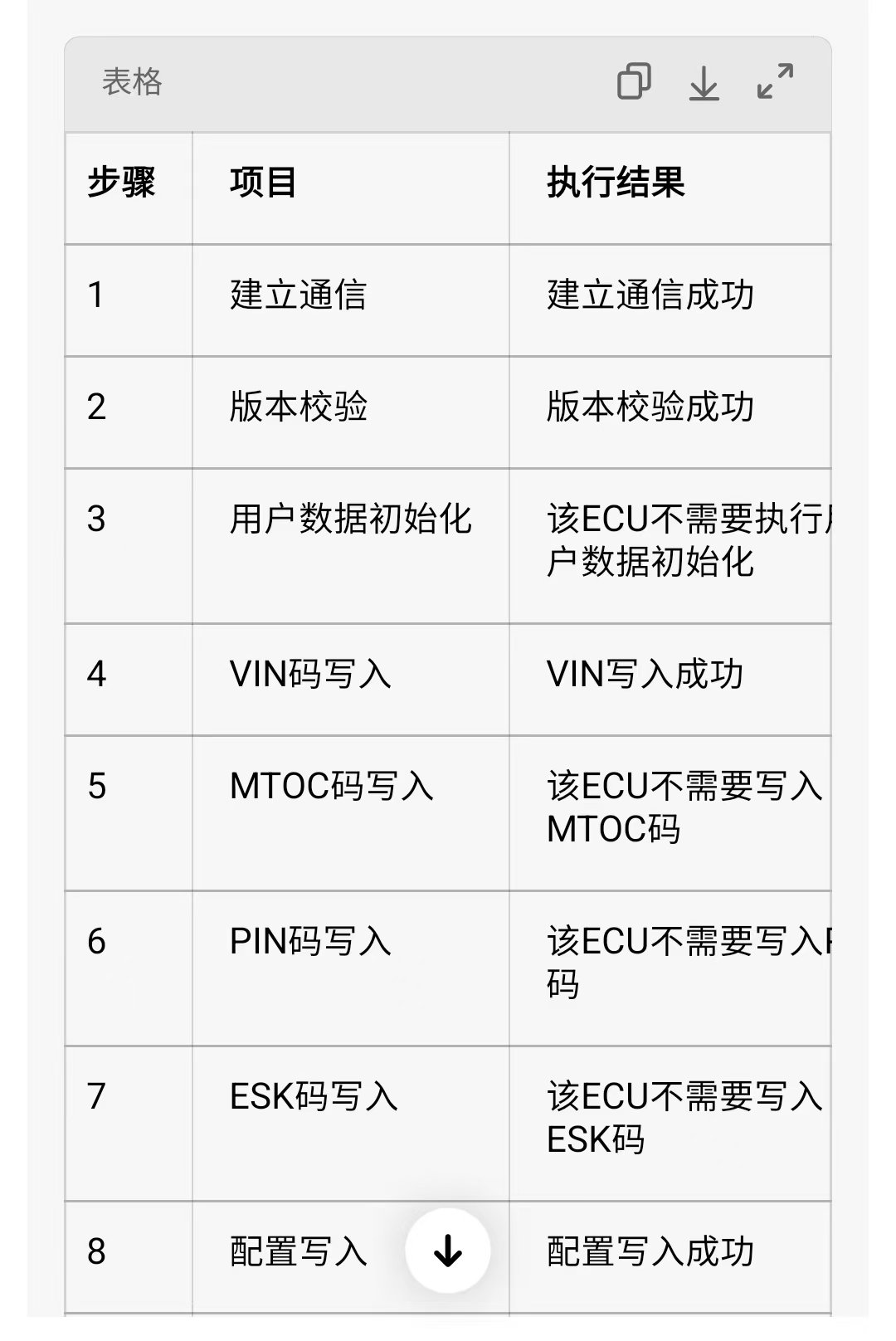
Programming sequence executed during the remote session: communication and version checks passed, VIN and configuration were written successfully, and SRS lock was activated.
Once the main configuration had been reset and reprogrammed, the vehicle was restarted and the stored fault codes were cleared. The workshop then ran a road test and reported the vehicle operating normally, at which point the laptop was disconnected.
No hardware was replaced. The remote diagnostic session itself was quoted at $100, with programming work quoted separately according to scope.
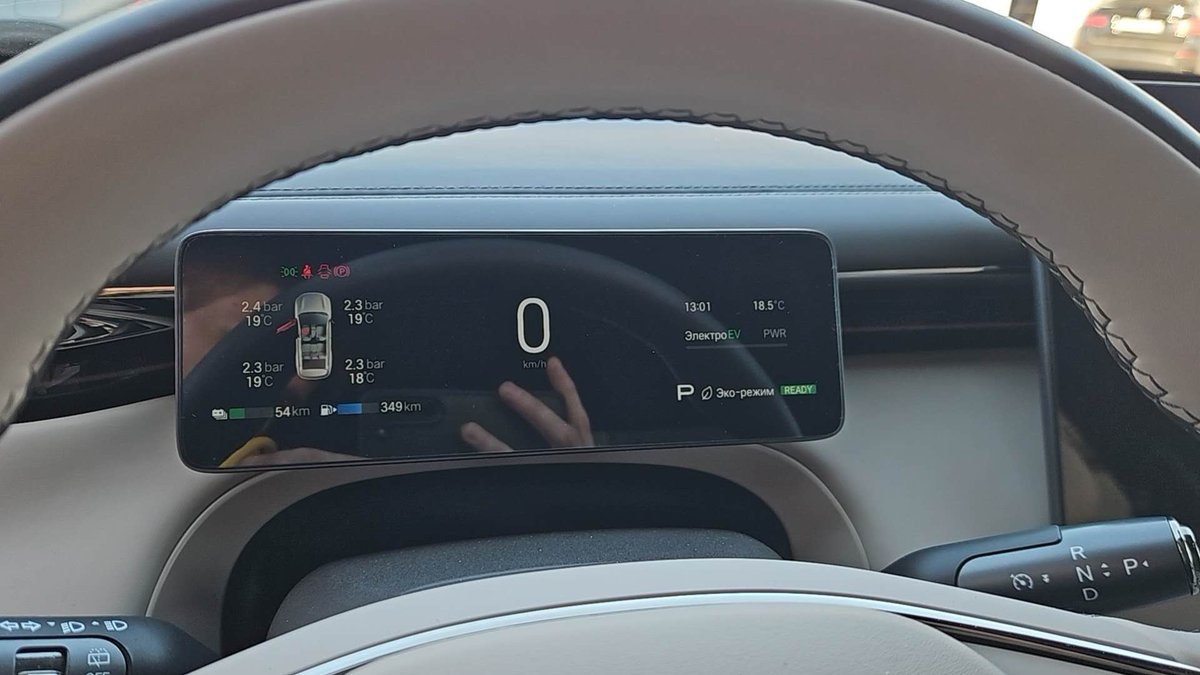
Instrument cluster after the repair: the vehicle is in EV ready mode, with the previously reported electronic and driver-assistance warnings cleared.
⚖️ Important Limits of This Diagnostic Evidence
We want to be precise about what this case does and does not establish, because the distinction matters for anyone reading it as a guide:
- Stored fault codes do not necessarily mean all 33 faults were active at the time of diagnosis. The report recorded zero current faults.
- The six ECUs listed as unable to communicate were unreachable during that specific session. This is a session finding, not automatically a permanent hardware failure.
- These findings are case-specific diagnostic evidence for one vehicle, not a general diagnosis applicable to all GAC Trumpchi S7 vehicles.
- The temporal sequence — software work followed by symptoms — is documented. The causal mechanism is not, and would require manufacturer-level configuration analysis to establish.
These limits matter because this article is a diagnostic report on one vehicle, not a guess about all GAC Trumpchi S7 vehicles. That is what allows the next workshop to use this case properly.
🌍 What This Case Means for Overseas EV Workshops
Three practical observations came out of this session that may be relevant beyond this one vehicle:
- This case shows why vehicle-specific diagnostic software can matter. The generic diagnostic information available to the workshop before this session was not sufficient to reach every domain; GAC GIDS over DOIP was what produced usable data across 16 ECUs — and the physical connection mattered as much as the software.
- Stored fault codes should not automatically be treated as active faults. A 33-code scan with zero current faults is a very different situation from 33 live failures. Reading that distinction correctly prevents a lot of unnecessary parts replacement.
- Diagnose before replacing hardware. The most visible symptom here — the head unit behaviour — was not resolved by swapping the head unit. Interpreting the diagnostic data first is what identified the actual programming action needed.
If your workshop is working on Chinese EVs without local dealer support, the diagnostic layer is often where the time gets lost, even when the underlying vehicle does not show a conventional mechanical fault. These are the types of cases for which NEV Fix provides remote diagnostic support. You can read more about how we run these sessions on our remote diagnostic support page, or see comparable cases such as the BYD Seal 05 charging fault diagnosed in Iraq and the Li Auto L9 module failure following an OTA update.
🔧 Remote Diagnostic Support for Chinese EVs
NEV Fix supports overseas workshops with remote diagnostic sessions on Chinese-brand electric and hybrid vehicles, including GAC Trumpchi models. Sessions are run using the vehicle's available diagnostic interface and the workshop's own equipment, so no hardware shipment is required before work begins.
Remote diagnostic sessions are quoted according to the vehicle, diagnostic scope and any programming work required — the case above was quoted at $100 for the diagnostic session itself. If a session identifies a hardware fault, we can also support parts sourcing through our parts lookup service, and longer-term capability building through our EV repair training programmes, including a dedicated battery repair course.
You can also browse further first-hand cases in our tech blog, including the Geely Geometry insulation fault case from Uruguay and the Zeekr region lock case study.
❓ Frequently Asked Questions
What did the remote diagnosis find on the GAC Trumpchi S7?
The diagnostic scan recorded 33 stored fault codes across 16 ECUs, with zero current faults at the time of the scan. Six additional ECUs — WHUD, FL radar, FR radar, INU, SRS and FCP — were listed as unable to establish communication.
Were all 33 fault codes active when the vehicle was diagnosed?
No. The diagnostic report recorded 33 historical fault codes and zero current faults. Stored historical codes do not necessarily mean all 33 faults were active at the time of diagnosis.
How was the GAC Trumpchi S7 connected for remote diagnosis?
The workshop used an ENET Ethernet diagnostic cable to establish a DOIP connection with the vehicle, while NEV Fix ran the GAC GIDS diagnostic software remotely through the workshop's connected laptop.
What happened after the configuration reset and programming?
The main configuration was reset and programmed, VIN and configuration data were written successfully, the stored fault codes were cleared, and the workshop reported that the vehicle returned to normal operation after a restart and road test.
Does diagnosing a GAC Trumpchi S7 overseas require brand-specific software?
In this case the workshop used GAC GIDS, the manufacturer diagnostic environment, over a DOIP connection. The generic diagnostic information available to the workshop before the session was not sufficient to reach all vehicle domains; GAC GIDS provided the vehicle-specific diagnostic data needed. A correct physical connection — an ENET cable and a working DOIP link — mattered as much as the software.
Dealing with a Chinese EV Your Workshop Cannot Fully Diagnose?
NEV Fix runs remote diagnostic sessions using your existing workshop equipment and the vehicle's own diagnostic interface. Send us the vehicle details and the symptoms — we will tell you what data to capture first.